
At a Glance
- Total Vacancies
- 11,127 posts across 17 Railway Zones and CLW
- Post Name
- Assistant Loco Pilot (ALP)
- Salary
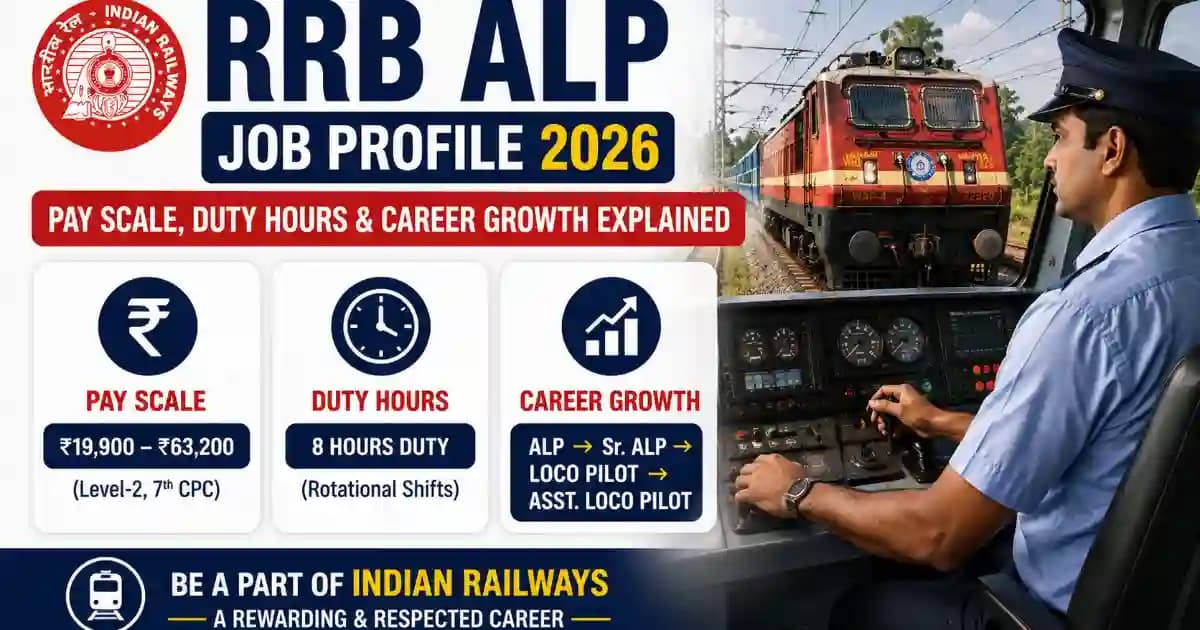
- Level 2 — 7th Central Pay Commission Pay Matrix
Quick Summary
Complete RRB ALP job profile for 2026 — actual daily duties, full salary breakdown with Running Allowance, duty hours rules, promotion path to Loco Pilot, and real employee experiences.
Most candidates checking the RRB ALP advertisement see the ₹19,900 basic pay and stop reading — they miss the Running Allowance, a separate kilometre-based payment that can add ₹5,000 to ₹12,000 per month on top of basic pay, making the actual in-hand salary significantly higher than the advertised figure. This guide breaks down every component of the ALP job — what you do inside the locomotive cabin, how your salary is actually calculated (with real numbers), what the duty hour rules say versus the on-ground reality, the full promotion path from ALP to Loco Inspector, the perks you collect along the way, and honest experiences from people already working in this role — so you know exactly what you are applying for before 14 June 2026.
What is the RRB ALP Post – Role at a Glance
The Assistant Loco Pilot (ALP) is the second crew member inside every railway locomotive cab, sitting alongside the senior Loco Pilot who drives the train. The ALP is not a trainee bystander — the role carries active operational responsibility: calling out signals verbally, monitoring speed, watching the track ahead, operating the horn at level crossings, assisting with emergency procedures, and handling minor on-duty maintenance. After gaining experience and clearing departmental exams, the ALP moves up to drive goods trains independently as a Loco Pilot, and from there to passenger and express services. The ALP is an entry-level operational role, not a clerical or technical support post.
| Aspect | Details |
|---|---|
| Post Name | Assistant Loco Pilot (ALP) |
| Recruiting Body | Railway Recruitment Board (RRB) — 21 regional boards |
| Notification | CEN 01/2026 |
| Total Vacancies 2026 | 11,127 posts across 17 Railway Zones and CLW |
| Pay Level | Level 2 — 7th Central Pay Commission Pay Matrix |
| Initial Basic Pay | ₹19,900 per month |
| In-Hand Salary (approx.) | ₹25,000 to ₹35,000/month (with all allowances, varies by city) |
| Work Location | Inside locomotive cabs on goods, passenger, and express trains. Posted to a Railway Division — not a desk or office. |
| Reporting Structure | Works under a senior Loco Pilot during operations. Administrative reporting to the Crew Controller and Divisional Mechanical Officer. |
| Application Portal | rrbapply.gov.in — online only, no offline mode |
| Expected Competition | 22 lakh+ applicants typically apply per ALP recruitment cycle |
Source: RRB CEN 01/2026 official notification — rrbapply.gov.in. Data verified as of May 2026.
RRB ALP Daily Duties & Work Details 2026 – What You Actually Do
The ALP's work is entirely field-based — inside a locomotive on active rail duty. There is no office desk, no fixed 9-to-5 schedule, and no option to work from home. Every duty begins with a sign-on at the Crew Lobby at your home station, where the Crew Controller assigns you a train, a Loco Pilot, and a route. From there, the duty could be anywhere from 4 hours on a short shunting assignment to 9 hours on an outstation goods train run.
| Duty Category | What the ALP Does | Frequency |
|---|---|---|
| Signal Observation & Calling | Verbally announces every trackside signal sighted — colour, aspect, and location — to the Loco Pilot. This is mandatory for all running duties at all speeds. | Every duty, continuously while train is moving |
| Horn Operation at Level Crossings | Operates the locomotive horn at prescribed distances before unmanned and manned level crossings as per Railway timetable instructions. | Every duty involving track with level crossings |
| Speed & Speedometer Monitoring | Watches the speedometer and alerts the Loco Pilot if speed approaches the permitted section limit or if the train enters a permanent/temporary speed restriction zone. | Every duty |
| Pre-Trip Locomotive Inspection | Joins the Loco Pilot in checking brake pressure, fuel/sand levels, horn function, headlight, cab cleanliness, and fire extinguisher before the train departs. | Before every outward trip |
| Minor On-Duty Maintenance | Handles minor issues during duty — topping up sand boxes, checking under-gear during scheduled halts, tightening accessible fittings. Major defects are reported, not self-repaired, on duty. | As required during running duty |
| Emergency Procedure Assistance | Assists the Loco Pilot in emergency brake application, communicating with the guard, flagging procedures, and track obstruction protocols. | As required — irregular occurrence |
| Log Book and Repair Book Entries | Makes prescribed entries in the locomotive repair book (noting faults observed) and duty register at sign-off. This is a regulatory requirement under Railway Board rules. | Every duty — at sign-on and sign-off |
| Outstation Duties (Goods Trains) | On goods train assignments, the ALP may travel to a distant station, rest in the outstation rest room provided by Railways, and return the next day on a fresh train. These are the most physically tiring duties. | Frequent for ALPs posted in goods-heavy divisions |
| Shunting Assistance | Assists the Loco Pilot during yard shunting operations — coupling/uncoupling wagons, ground-level inspection of brakes between shunting moves. | As assigned — varies by division |
Source: Indian Railways operational procedures, Railway Board circulars, and CEN 01/2026 official notification job description. Data verified as of May 2026.
RRB ALP Pay Scale 2026 – Full Salary Breakdown with Running Allowance
The published basic pay of ₹19,900 is only the starting point. What you actually receive in hand each month depends on six components — and Running Allowance, which most candidates overlook, is often the largest variable component. An ALP posted in a major city with a heavy running duty schedule can collect ₹10,000 to ₹12,000 per month in Running Allowance alone on top of their fixed salary, pushing in-hand salary well past ₹35,000.
| Salary Component | Rate / Calculation | Approximate Monthly Amount (Entry Level) | Notes |
|---|---|---|---|
| Basic Pay | Fixed — Pay Level 2 (7th CPC) | ₹19,900 | Increases by 3% annual increment. Maximum of Pay Level 2 is ₹35,400 after increments. |
| Dearness Allowance (DA) | ~50% of Basic Pay (revised quarterly based on CPI) | ₹9,950 | DA was at 50% as of early 2026. Revised every 6 months — April and October. |
| House Rent Allowance (HRA) | 27% of Basic (X cities) / 18% (Y cities) / 9% (Z cities) | ₹1,791 – ₹5,373 | OR Railway quarter allotted instead of HRA — you cannot claim both. Metro postings: higher HRA. |
| Transport Allowance (TA) | Slab-based by city tier + 50% DA on TA | ₹1,350 – ₹3,600 | Revised periodically. Not payable when on outstation duty for the days away. |
| Running Allowance (RA) | Per-kilometre rate for actual distance operated on duty | ₹5,000 – ₹12,000+ | This is the key variable. ALPs on busy goods corridors (Mumbai–Delhi, HWH–NDLS) earn significantly more RA. RA replaces TA on days running duty is performed. |
| Night Duty Allowance (NDA) | Paid per hour of duty performed between 10 PM and 6 AM | ₹500 – ₹1,500 | Paid only for actual night-time running hours. Varies greatly depending on shift pattern. |
| New Pension Scheme (NPS) Deduction | 10% of Basic Pay + DA — deducted from salary | –₹2,985 (employee share) | Government contributes 14% additionally. NPS replaces the old defined pension. Retirement corpus, not monthly pension. |
| Other Standard Deductions | Income Tax (if applicable), Professional Tax (state), CGEIS | –₹500 – ₹1,500 | Income tax applicable if gross annual salary exceeds ₹3 lakh. Low to negligible at entry level ALP salary. |
Source: 7th Central Pay Commission Pay Matrix (Level 2), Railway Board Running Allowance circulars, and CEN 01/2026 official notification. DA figure based on January 2026 revision. Data verified as of May 2026.
RRB ALP Duty Hours & Work Schedule 2026 – Rules vs Reality
The Railway Board sets specific rules for how many hours a Loco Pilot or ALP can work in a single shift. These rules exist because operating a train demands full alertness — fatigue directly impacts safety for millions of passengers. Here is what the rules say, and what the day-to-day schedule actually looks like.
| Rule / Schedule Element | Official Provision | Practical Reality |
|---|---|---|
| Maximum shift duration | 11 hours total duty per shift (as per Railways Act, 1989 rules for running staff) | Delays, late running, and waiting time at stations can push total time beyond 11 hours in practice on certain routes. Railway Board is on record requesting compliance. |
| Maximum continuous running duty | 9 hours of actual driving / running operation in a single stretch | Observed more consistently than total shift duration — relief change-over at major junctions manages this. |
| How you get called for duty | Crew Controller gives a call-up 2 hours before your reporting time | Can be any time — 2 AM, 4 AM, 10 PM. There are no fixed shifts like morning/evening. You must be available and ready on 2 hours notice when you are on the active roster. |
| HQ (Home Station) Rest after return | 16 hours of rest at home station after returning from an outstation duty | Generally maintained for planned outstation runs. Short-haul return duties may get processed faster with crew controller approval. |
| Outstation Rest | 8 hours rest at outstation lodging facility (Railway Rest House) | Rest rooms are available at major outstation stations. Quality varies — some rest houses are well-maintained, others basic. Outstation rest is not 8 hours of uninterrupted sleep — call-up can come after 6 hours. |
| Roster system | No fixed weekly off — rest days are determined by the crew management roster, which rotates continuously | There is no "Sunday off." Days and nights rotate. Some ALPs get 10–11 rest days in a month if duties are spread well; heavy traffic months can mean fewer rest days. Festival seasons are the most demanding. |
| Leave entitlement | Earned Leave (30 days/year), Casual Leave (8 days/year), Sick Leave, and Special Casual Leave | Leave is subject to availability of relief — during peak freight and passenger seasons (Diwali, summer vacation), leave approvals can be delayed. Planned leave needs advance application. |
| Night duty | Night Duty Allowance paid for hours between 10 PM and 6 AM | Night duties are frequent and unavoidable given the continuous railway operation schedule. New ALPs are typically on a mixed roster from day one — no "adjustment period" before night duties begin. |
Source: Railways Act, 1989 (Hours of Employment Rules for running staff), Railway Board circulars, and CEN 01/2026 official notification. Data verified as of May 2026.
RRB ALP Career Growth 2026 – Promotion Path from ALP to Loco Inspector
The ALP post has one of the clearest promotion paths in government service. Every stage has defined criteria — seniority, departmental examination performance, medical fitness renewal, and driving record. There is no external competitive exam after joining; all promotions are internal. The time it takes depends on the cadre strength in your zone and the vacancy position at each level — but the path itself is fixed and well-established.
| Stage | Designation | Pay Level (7th CPC) | Typical Timeline | Key Requirement |
|---|---|---|---|---|
| 1 | Assistant Loco Pilot (ALP) | Level 2 — ₹19,900 to ₹35,400 | Joining — Year 0 to 3–5 years | Operates under the Loco Pilot. Builds route knowledge and signal-reading competency. Mandatory training period at Zonal Training Centre post-joining. |
| 2 | Senior Assistant Loco Pilot | Level 2 (higher increments) | After 3–5 years of satisfactory service + departmental exam | Departmental exam on technical and rules subjects. A-1 medical fitness renewal. Seniority-based shortlisting in the division. |
| 3 | Loco Pilot (Goods) | Level 4 — ₹25,500 to ₹81,100 | After Senior ALP status + qualifying departmental exam for independent driving | Drives goods trains independently. Route learning on assigned sections mandatory. Traction knowledge exam required. Major pay jump at this stage. |
| 4 | Loco Pilot (Passenger) / Loco Pilot (Mail/Express) | Level 4 to Level 5 — ₹29,200 to ₹92,300 | After years of goods train operation + performance record + exam | Drives passenger and mail/express trains. Higher responsibility. Running Allowance increases significantly with passenger train assignments. |
| 5 | Senior Loco Pilot | Level 6 — ₹35,400 to ₹1,12,400 | 10–15 years from joining, based on zone vacancy | Highest field-level operational role. Mentors new Loco Pilots informally. Maximum Running Allowance benefit at this level. In-hand salary ₹55,000–₹70,000/month. |
| 6 | Loco Inspector / Loco Foreman | Level 6 to Level 7 | 12–18 years from joining | Supervisory role. Responsible for checking other Loco Pilots, investigating incidents, and evaluating operational standards. Desk and field work combined. No independent train driving at this stage. |
| 7 | Power Controller / Crew Controller | Level 7+ | 15–20 years from joining | Manages crew deployment for the entire division. Controls who goes on which train, handles emergency crew changes, and coordinates with traffic and operations departments. Largely office-based at this stage. |
Source: Indian Railways promotion rules for running staff, Railway Board notifications, and CEN 01/2026 official notification. Pay Matrix from 7th CPC. Timeline is indicative — actual time depends on zone vacancy position. Data verified as of May 2026.
RRB ALP Perks & Benefits 2026 – Complete List
Beyond the monthly salary and Running Allowance, the ALP post comes with a set of non-monetary benefits that make the total employment package significantly more valuable than the basic pay number suggests — especially for candidates coming from private sector ITI or diploma jobs where medical costs and travel are out-of-pocket expenses.
| Benefit | What You Get | Value to the Employee |
|---|---|---|
| Free Medical Facility | You and your dependent family members get free outpatient and inpatient treatment at all Railway hospitals and empanelled private hospitals under the Railway Health Service (RHS). | High. Covers major surgeries, specialist consultations, medicines — same quality as CGHS. A family health insurance equivalent of ₹5–10 lakh/year for most families. |
| Free Railway Travel Passes | You receive free privilege passes (PTOs) for yourself and your family for rail travel across India each year. Type of pass depends on grade — ALPs get a set number of privilege passes plus additional PTOs (Privilege Ticket Orders). | High for families that travel. Reduces annual travel costs substantially. Commonly used for annual holidays, hometown visits, pilgrimages. |
| Railway Quarters / Housing | Depending on availability at your division, Railway residential quarters may be allotted. HRA is not payable if a quarter is occupied. | Moderate. Not guaranteed at all stations. Major junction divisions (Mumbai, Delhi, Secunderabad) have long waiting lists. Tier-3 stations have faster allotment. |
| New Pension Scheme (NPS) | 10% of your basic + DA goes into NPS. The government contributes 14% additionally — making total NPS contribution 24% of (Basic + DA) per month. | Long-term. Not a monthly pension like the old OPS — the corpus grows with market returns and is available at retirement. The government's 14% contribution is a significant employment benefit. |
| Gratuity | On retirement or after 5 years of continuous service (in case of death/disability), a lump-sum gratuity is paid — up to a maximum of ₹20 lakh under current rules. | Retirement security. Calculated as 15/26 × monthly pay × completed years of service. |
| Leave Travel Concession (LTC) | Free or concessional travel for self and family to home town (once in 2 years) or anywhere in India (once in 4 years) under the All India LTC scheme. | Supplementary to the regular passes. Railway employees can combine passes and LTC strategically for maximum coverage. |
| Earned Leave Encashment | Up to 300 days of accumulated earned leave can be encashed at retirement — calculated at last drawn pay. | A significant lump sum at retirement. ALPs who plan leave carefully over a 30-year career can encash 200–300 days at a high pay scale. |
| Railway Schools for Children | Children of Railway employees get priority admission in Kendriya Vidyalayas and Railway Schools near posting stations — with heavily subsidised fee structures. | High for families with school-age children. Reduces education expense significantly at quality schools. |
| Group Insurance | Central Government Employees Group Insurance Scheme (CGEGIS) — life insurance cover with a small monthly deduction. | Supplementary life cover. Not substantial in absolute terms but is part of the overall employment protection package. |
| Rest House Accommodation on Outstation Duty | Railway-provided rest rooms at outstation stations for crew on duty — free accommodation, basic meals facility at Running Room. | Practical. Outstation ALPs do not pay for accommodation — all rest between outstation runs is in Railway-provided crew rest facilities at no personal cost. |
Source: Indian Railways HR policy, Railway Board benefit circulars, and official CEN 01/2026 notification. Data verified as of May 2026.
What Current ALP Employees Say – Real Experiences from the Field
The salary tables and duty hour rules give you the official picture. These are real-ground perspectives from people working in the ALP role — their words represent experiences shared across Railway employee communities by working and former loco running staff. Names and specific divisions have been kept general to protect individual privacy.
Ramesh B., ALP — South Central Railway, 2 years of service: "I did my ITI in Electronics Mechanic and spent a year in a private wiring company earning ₹12,000 a month with no benefits. When I cleared ALP and joined, the first thing I noticed was how different the in-hand felt once the Running Allowance kicked in after my first full month on active duty. I was making ₹28,000 in my first year. Add free medical for my wife and parents, no rent because I got a quarter quickly at a smaller station — the effective income is much more than the ₹19,900 people see in the advertisement. The irregular call times took 4–5 months to stop feeling strange. Now I do not even think about it."
Priya M., ALP — Western Railway, 3 years of service: "I am a diploma holder from Pune. I was working in an automobile workshop and the money was decent but zero stability, zero medical. Cleared ALP in 2022 cycle, joined in 2023. The hardest part for me was getting used to the outstation goods train duties — I am away from home for 30 to 36 hours sometimes before returning. The rest rooms at outstations vary a lot — some are clean and air-conditioned, some are very basic. But what nobody tells you is that the Running Allowance on goods corridors is very good. My in-hand in the third year — with moderate running duties — is crossing ₹32,000. And I have not paid a hospital bill since I joined."
Anand K., ALP — Northeast Frontier Railway, 7 years of service, now Senior ALP: "Seven years in, I am preparing for the Loco Pilot (Goods) departmental exam now. The honest truth about the job: the first 2 years are the toughest adjustment — no Sunday, no holiday predictability, night call-ups. But by year 3 or 4, you develop a rhythm with the roster and your body adjusts better than you expect. What surprised me most is how much railway running knowledge you accumulate — after 7 years I know every gradient, curve, and signal position on my assigned sections. That expertise is not something you can get anywhere else. My salary now with RA is around ₹38,000. Once I get to Loco Pilot (Goods), it will be a big jump. Career is clear — just takes patience."
Kavitha N., wife of an ALP — East Coast Railway, 4 years: "My husband joined ALP 4 years back from a welding ITI background. From a family perspective: the irregular hours did create tension in the first year — you cannot plan family events easily because his duty call can come at any time. But the benefits changed our financial life. Our two kids study in the Railway school near our quarter — we pay almost nothing in fees. We used the privilege passes last year to take our first family holiday to Ooty — no ticket cost. His medical card covers the whole family. It is not an easy job for the family to manage, but if you plan around it, the security it gives is something his old private job could never have matched."
Dinesh R., B.Tech (Electrical) graduate — ALP, Central Railway, 1 year of service: "I chose ALP over an IT job offer. People thought I was wrong. In-hand in tech at entry level was around ₹22,000 in the city I had an offer in, with a ₹15,000 rent. My ALP in-hand in Nagpur where I am posted — ₹28,000, railway quarter at ₹800/month rent, free medical. I am genuinely more stable at 22 years old in this job than I would have been in that IT offer. The work is physically demanding and the call-up system is an adjustment. But the psychological part — knowing your job is permanent, your medical is covered, and your promotion path is written — that peace of mind is not available at most private jobs at this qualification level."
RRB ALP 2026 – Official Links
| Resource | Official Link |
|---|---|
| Apply Online – RRB ALP CEN 01/2026 | rrbapply.gov.in |
| Official Notification PDF – CEN 01/2026 | Download CEN 01/2026 PDF |
| Indian Railways Official Website | indianrailways.gov.in |
Application closes 14 June 2026 | Updated May 2026
RRB ALP Job Profile 2026 – Frequently Asked Questions
What is the actual in-hand salary of RRB ALP per month in 2026? +
The actual in-hand salary for a freshly joined RRB ALP in 2026 ranges from ₹25,000 to ₹35,000 per month depending on posting city and running duties performed. Basic pay is ₹19,900, plus Dearness Allowance (~50% of basic = ~₹9,950), HRA (9% to 27% of basic based on city tier), Running Allowance (₹5,000 to ₹12,000 based on km operated), and Night Duty Allowance if applicable — minus 10% NPS deduction. ALPs in metro cities or heavy goods corridors typically reach the ₹33,000 to ₹35,000 range within the first year of active running duty.
What is Running Allowance in RRB ALP salary — how is it calculated? +
Running Allowance (RA) is a per-kilometre payment made to locomotive running staff — ALP, Loco Pilot, and Guard — for the actual distance their train travels while they are on duty. The rate is prescribed by the Railway Board and is revised periodically. An ALP on active running duty earns RA for every kilometre operated. On a busy corridor (say a 300-km goods train run), a single duty can earn ₹800 to ₹1,200 in RA. ALPs who average 400 to 600 km per month in running duty will earn ₹5,000 to ₹8,000 in RA — those on high-traffic corridors with more runs can earn ₹10,000 to ₹12,000. Running Allowance is not paid when the ALP is on leave, training, or non-running duty days.
Does RRB ALP have fixed working hours or shift timing? +
No. There are no fixed shifts for RRB ALP staff. The Crew Controller calls you 2 hours before your duty is to begin — this can be at any time, day or night, including 1 AM or 3 AM. The Railway Board rules state that a single shift should not exceed 11 hours total, and running duty should not exceed 9 continuous hours. Weekly rest is roster-based, not fixed on Sundays. Most ALPs get 10 to 12 rest days per month but there is no guaranteed day-off on any specific day of the week.
How long does it take to get promoted from ALP to Loco Pilot? +
The typical timeline from ALP to Loco Pilot (Goods) — the first independent driving role — is 5 to 8 years, depending on your Railway Zone's cadre vacancy position. You must first become Senior ALP (after 3–5 years), clear the departmental exam for independent driving, complete route learning on your assigned sections, and pass the A-1 medical fitness test again at the promotion stage. Zones with higher vacancy rates (due to retirements or expansion) promote faster — NF Railway and East Coast Railway have historically had faster promotion cycles than Western Railway or Northern Railway where the cadre is larger.
Is the RRB ALP job transfer-heavy — will I be posted far from home? +
Transfers in the ALP cadre typically happen within the same Railway Zone — not across zones. You apply to one specific RRB zone during the application, and your service usually stays within that zone's divisions. Transfers between divisions within the zone do happen based on vacancy needs and personal requests. If you are posted to a major junction city (Mumbai, Delhi, Hyderabad), inter-division transfers are less frequent. Candidates from states like UP, Bihar, or Rajasthan should note that applying to zones closer to their home state reduces the chance of being posted very far from family.
What happens to my ALP job if my vision deteriorates after joining? +
Vision is tested at every promotion stage and periodically during service as part of routine Railway medical checkups. If your unaided vision falls below 6/6 in either eye at any stage, you will be declared medically unfit for the ALP and Loco Pilot running duties. The Railway has an alternative employment provision — medically downgraded running staff can be considered for non-running posts within the railways, but this involves a pay cut and change of role. LASIK surgery to correct vision is not permitted even after joining — it remains a permanent disqualifier for the running post.
Is there a training period after joining as ALP — what does it cover? +
Yes. After joining, every newly selected ALP goes through a mandatory induction training at the Zonal Training Centre (ZTC) or Diesel/Electric Loco Shed. The training covers locomotive mechanics and systems, traction knowledge for the type of locomotive you will operate, Railway rules and signal procedures, emergency handling, and safety protocols. Duration is typically 6 to 12 months depending on the zone and traction type (diesel or electric). You receive your basic pay during training. Active running duty with Running Allowance begins only after training and practical certification are complete.
Can women candidates apply for RRB ALP 2026 — are there any restrictions? +
Yes, women candidates are fully eligible to apply for RRB ALP CEN 01/2026 under the same eligibility conditions as male candidates. There is no separate restriction based on gender for the ALP post in the 2026 notification. Female candidates from SC/ST/PwBD categories and all female candidates irrespective of category pay a reduced application fee of ₹250 (versus ₹500 for male UR candidates). The A-1 medical standard applies equally — vision, colour perception, and hearing requirements are the same for all candidates. Women ALPs in Indian Railways work the same roster system as male counterparts.
What is the salary of a Senior Loco Pilot — how much can an ALP earn after 10 years? +
A Senior Loco Pilot (the level an ALP can reach in 10 to 15 years) is on Pay Level 6 of the 7th CPC — basic pay of ₹35,400 to ₹1,12,400 depending on increments. At the mid-level of Senior Loco Pilot service with accumulated increments, the basic pay would typically be in the ₹45,000 to ₹55,000 range. Add DA (50%+), HRA, and the significantly higher Running Allowance at the Senior LP level (which operates faster trains over longer distances), and the total in-hand package comfortably crosses ₹55,000 to ₹70,000 per month. Loco Pilots with 15+ years regularly report in-hand packages in this range.
Is the RRB ALP job good for a B.Tech graduate or only for ITI holders? +
The ALP role is operationally identical for all joining candidates — your qualification route (ITI, Diploma, or B.Tech) determines eligibility but not your role or salary after joining. A B.Tech graduate and an ITI holder both join at the same Pay Level 2 and follow the same promotion path. The decision should be based on lifestyle fit, not qualification level. If you value job security, a clear promotion path, non-office field work, and government benefits over salary maximisation in the early years — ALP is a strong choice for B.Tech holders too, especially given the poor private sector job market for non-CS engineering graduates in tier-2 and tier-3 cities. Many B.Tech (Electrical, Mechanical) graduates actively prefer ALP over uncertain private sector placements.