
At a Glance
- Total Vacancies
- 3,951 Posts (SCI: 322 | BCI: 3,629)
- Post Name
- Senior Computer Instructor (SCI) & Basic Computer Instructor (BCI)
- Exam / Result Date
- 22 August 2026 (Combined for SCI & BCI)
- Application Last Date
- 23 June 2026
- Application Start Date
- 25 May 2026
- Salary
- ₹33,800 – ₹1,07,000 (Pay Level 10, 7th CPC)
- Conducting Body
- Rajasthan Staff Selection Board (RSSB), Jaipur
- Eligibility
- BCA / B.Sc CS / B.Tech / MCA / M.Sc CS (post-wise)
Quick Summary
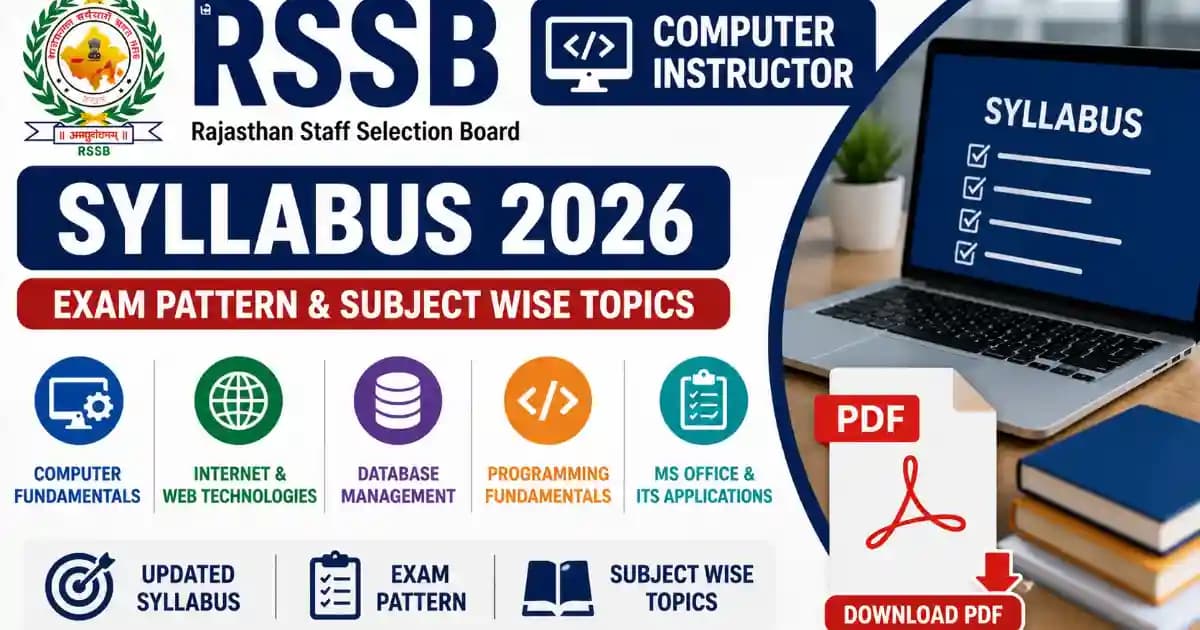
RSSB Computer Instructor Syllabus 2026 (Advt. 07/2026) covers two papers – GK & Reasoning (Paper I) and Technical Computer Science (Paper II) for SCI & BCI posts. Download the subject-wise PDF at rssb.rajasthan.gov.in.
Rajasthan Staff Selection Board (RSSB), Jaipur, is the state-level recruitment body operating under the Government of Rajasthan responsible for selecting candidates for non-gazetted posts in various state departments. Its official recruitment portal is rssb.rajasthan.gov.in.
RSSB Computer Instructor Syllabus 2026 – Overview
RSSB Computer Instructor Recruitment 2026 follows a clean two-paper written exam structure — no interview, no physical test — making it one of the more transparent government teaching recruitments in Rajasthan this cycle. Rajasthan Staff Selection Board (RSSB) has released the official syllabus under Advt. No. 07/2026 for 3,951 posts (Senior Computer Instructor / SCI: 322 posts; Basic Computer Instructor / BCI: 3,629 posts) across the Secondary Education Department and Sanskrit Education Department, Rajasthan. Paper I (General Knowledge & Reasoning) is identical for both posts; Paper II (Technical / Computer Science) differs — SCI covers PG-level advanced topics while BCI covers UG-level fundamentals. The written exam is scheduled for 22 August 2026. Applications are accepted online at sso.rajasthan.gov.in from 25 May 2026 to 23 June 2026. Minimum qualification for BCI is BCA / B.Sc CS / B.Tech; for SCI it is MCA / M.Sc CS / M.Tech. Application fee is ₹600 for General/OBC (Creamy Layer)/EWS candidates; ₹400 for OBC Non-Creamy Layer, SC/ST, and PwBD candidates.
| Detail | Information |
|---|---|
| Conducting Body | Rajasthan Staff Selection Board (RSSB), Jaipur |
| Advertisement No. | 07/2026 | Ref: P.14(169)RSSB/Arthna/School Shiksha/Computer Anudeshak/Bharti/2025 |
| Post Names | Senior Computer Instructor (SCI) & Basic Computer Instructor (BCI) |
| Departments | Secondary Education Department & Sanskrit Education Department, Rajasthan |
| Total Vacancies | 3,951 Posts (SCI: 322 | BCI: 3,629) |
| Exam Date | 22 August 2026 (Combined for SCI & BCI) |
| Application Period | 25 May 2026 to 23 June 2026 |
| Application Mode | Online via SSO Portal – sso.rajasthan.gov.in |
| Exam Mode | Offline – OMR Sheet Based, Objective MCQ |
| Total Papers | 2 Papers (Paper I + Paper II) |
| Total Questions | 200 MCQs (100 per paper) |
| Total Marks | 200 Marks (100 per paper) |
| Total Duration | 4 Hours (2 hours per paper) |
| Negative Marking | 1/3 mark deducted per wrong answer |
| Exam Language | Hindi & English (Bilingual) |
| SCI Pay Scale | ₹33,800 – ₹1,07,000 (Pay Level 10, 7th CPC) |
| BCI Pay Scale | ₹25,500 – ₹81,100 (Pay Level 8, 7th CPC) |
| Official Website | rssb.rajasthan.gov.in |
Source: Official RSSB Notification Advt. No. 07/2026 | rssb.rajasthan.gov.in
RSSB Computer Instructor 2026 – Important Dates & Exam Schedule
All key dates for RSSB Computer Instructor Recruitment 2026 are confirmed in the official notification Advt. No. 07/2026. The application window and exam date are fixed; candidates must plan their preparation timeline accordingly.
| Event | Date |
|---|---|
| Application Start Date | 25 May 2026 |
| Application Last Date | 23 June 2026 |
| Written Exam Date (SCI & BCI Combined) | 22 August 2026 |
| Admit Card Available | To be announced – check rssb.rajasthan.gov.in |
| Result Date | To be announced – check rssb.rajasthan.gov.in |
Source: RSSB Official Notification 07/2026 | rssb.rajasthan.gov.in
RSSB Computer Instructor 2026 – Vacancy Details (Post & Department-wise)
RSSB Computer Instructor 2026 fills 3,951 posts across two departments in Rajasthan. The vacancies are split between scheduled and non-scheduled areas as shown below.
| Post | Department | Non-Scheduled Area | Scheduled Area | Total |
|---|---|---|---|---|
| Senior Computer Instructor (SCI) | Secondary Education | 278 | 44 | 322 |
| Basic Computer Instructor (BCI) | Secondary Education | 3,063 | 473 | 3,536 |
| Basic Computer Instructor (BCI) | Sanskrit Education | 83 | 10 | 93 |
| Grand Total | 3,424 | 527 | 3,951 | |
Source: RSSB Advt. 07/2026 | rssb.rajasthan.gov.in
RSSB Computer Instructor 2026 – Exam Pattern (SCI & BCI)
RSSB Computer Instructor 2026 exam pattern is identical in format for both SCI and BCI — two papers conducted on the same day on 22 August 2026. The key difference lies only in Paper II: SCI Paper II covers PG/advanced topics, while BCI Paper II covers UG-level computer science fundamentals.
RSSB SCI Exam Pattern 2026
| Paper | Subject | Questions | Marks | Duration |
|---|---|---|---|---|
| Paper I | General Knowledge & Awareness | 100 | 100 | 2 Hours |
| Paper II | Computer Subject (Technical – PG Level) | 100 | 100 | 2 Hours |
| Total | 200 | 200 | 4 Hours | |
RSSB BCI Exam Pattern 2026
| Paper | Subject | Questions | Marks | Duration |
|---|---|---|---|---|
| Paper I | General Knowledge & Reasoning | 100 | 100 | 2 Hours |
| Paper II | Computer Subject (Technical – UG Level) | 100 | 100 | 2 Hours |
| Total | 200 | 200 | 4 Hours | |
Marking Scheme – RSSB Computer Instructor 2026
| Answer Type | Marks |
|---|---|
| Correct Answer | +1 mark |
| Wrong Answer | –1/3 mark (Negative Marking) |
| Unattempted Question | 0 mark |
Source: RSSB Advt. 07/2026 | rssb.rajasthan.gov.in
RSSB Computer Instructor 2026 – Paper I Syllabus (Common for SCI & BCI)
Paper I for RSSB Computer Instructor 2026 is common to both SCI and BCI posts — 100 questions carrying 100 marks to be attempted in 2 hours. It covers Rajasthan GK (highest weightage), India GK, Current Affairs, and Mental Ability & Reasoning.
Section 1: Rajasthan General Knowledge (Highest Weightage)
| Topic | Key Sub-topics |
|---|---|
| History of Rajasthan | Important battles & wars; Major dynasties – Mewar, Marwar, Amber/Jaipur; Freedom struggle in Rajasthan; Integration of Rajasthan; Famous rulers – Maharana Pratap, Prithviraj Chauhan, Man Singh I; Historical monuments – Chittorgarh, Amber, Hawa Mahal |
| Art, Culture & Heritage | Folk dances – Ghoomar, Kalbelia, Chari, Terah Taali; Folk music & instruments; Famous fairs & festivals – Pushkar, Teej, Gangaur, Urs; Handicrafts – Blue pottery, Bandhej, Leheriya; Paintings – Bundi, Kota, Kishangarh, Mewar schools; Languages & dialects; Major temples |
| Geography of Rajasthan | Physical divisions – Thar Desert, Aravalli Range, Eastern Plains; Rivers – Chambal, Luni, Banas, Ghaggar; Soils & crops; Climate; Wildlife sanctuaries – Ranthambore, Sariska, Keoladeo; Minerals – marble, granite, zinc, copper; Districts, divisions & boundaries |
| Economy of Rajasthan | Agriculture – bajra, wheat, mustard; Industries – cement, textile, handicraft; Tourism; Major irrigation projects; RIICO & industrial policies; Important dams – Bisalpur, Jawahar Sagar; Rajasthan Budget highlights |
| Polity & Administration | Rajasthan Panchayati Raj Act; State legislature & Governor; Govt. schemes – Mukhyamantri Chiranjeevi, Jan Aadhaar, Palanhar; State commissions; Lok Ayukta |
| Current Affairs (Rajasthan) | Recent appointments; State awards & honours; New schemes & policies; Sports achievements by Rajasthan athletes; Infrastructure & development projects |
Section 2: India General Knowledge
| Topic | Key Areas |
|---|---|
| Indian History | Ancient, medieval & modern history; Freedom struggle; Major events; Important personalities |
| Indian Geography | Physiographic divisions; Rivers & dams; Climate; Natural resources; States & capitals |
| Indian Polity | Constitution – Fundamental Rights, DPSPs; Parliament; President & PM; Judiciary; Amendments |
| Indian Economy | Budget basics; GDP, inflation; Five-year plans; RBI & banking; Poverty alleviation schemes |
| Science & Technology | Space missions – ISRO; Defence tech; Recent inventions; National awards in science |
| Environment | Climate change; Wildlife protection acts; National parks; Pollution control; Green energy |
Section 3: Current Affairs (National & International)
Major national & international events of the last 12 months are tested, covering important appointments & resignations (Governors, CJI, heads of bodies), sports championships (Olympics, World Cups, Rajasthan athletes), awards & honours (Bharat Ratna, Padma Awards, Nobel Prize), Science & Technology (ISRO missions, AI developments), Government schemes (PM schemes, Rajasthan schemes), books & authors, important national/international days, summit meetings (G20, climate conferences), and UN resolutions.
Section 4: Mental Ability & Logical Reasoning
| Topic | Sub-topics |
|---|---|
| Number & Letter Series | Completing patterns; Finding missing terms; Number sequences |
| Analogy | Semantic, symbolic & figural analogies; Relationship-based |
| Classification (Odd-One-Out) | Word, number, figure-based; Conceptual odd-one-out |
| Coding – Decoding | Letter coding; Number coding; Symbol coding; Substitution |
| Blood Relations | Family tree; Coded family relations |
| Direction & Distance | Direction sense; Distance calculations; Map-based reasoning |
| Logical Reasoning | Syllogism; Statement-Conclusion; Statement-Assumption; Inference |
| Data Interpretation | Tables; Bar graphs; Pie charts; Line graphs; Mixed graphs |
| Data Sufficiency | Two-statement sufficiency; Determining data adequacy |
| Decision Making | Problem-solving scenarios; Situational judgement |
| Arithmetic Reasoning | Age problems; Profit-loss; Speed-distance; Calendar; Clock |
| IT Developments (Reasoning) | Major recent developments in Information Technology; AI & ML basics |
Source: RSSB Advt. 07/2026 | rssb.rajasthan.gov.in
RSSB SCI Syllabus 2026 – Paper II Technical (Senior Computer Instructor)
RSSB SCI Paper II covers PG-level and advanced computer science topics — 100 questions, 100 marks, 2 hours. The 17 major subject areas are listed in full below. SCI candidates must focus on advanced algorithms, network security, digital logic, and system architecture in addition to core topics.
1. Pedagogy (Teaching Methodology) – SCI
Principles of teaching computer science in secondary schools; lesson planning & instructional design for IT subjects; ICT in education – smart class, e-learning, LMS; assessment & evaluation techniques; child psychology & learner-centered approaches; Bloom's Taxonomy in CS education.
2. Mental Ability & IT Awareness – SCI
Decision making & problem solving; data interpretation & data sufficiency; logical reasoning & analytical ability; major developments in IT – AI, IoT, Cloud computing.
3. Fundamentals of Computer – SCI
Number systems – Binary, Octal, Decimal, Hexadecimal; conversions; BCD, ASCII, Unicode; arithmetic operations – addition, subtraction (2's complement), multiplication; computer generations (1st to 5th); classification of computers; functional details of input/output devices; memory hierarchy – registers, cache, RAM, ROM, secondary storage; data representation – signed/unsigned integers, floating point (IEEE 754).
4. Programming Fundamentals – SCI
C language – data types, operators, control flow, functions, arrays, pointers, structures, unions, file handling, command-line arguments; C++ – classes & objects, constructors & destructors, operator overloading; Java – OOP concepts, packages, interfaces, exception handling, multithreading, collections; Python – syntax, data types, list/dict/tuple, comprehensions, file I/O, NumPy basics; DotNet framework – CLR, C# syntax; Artificial Intelligence (AI) – search algorithms (BFS, DFS, A*), knowledge representation; Machine Learning – supervised vs unsupervised, regression, classification basics, scikit-learn; Blockchain – distributed ledger, consensus mechanisms, smart contracts, cryptocurrency basics; scope of variables, precedence of operators, recursion.
5. Object-Oriented Programming (C++ & Java) – SCI
Objects & classes; encapsulation & data hiding; inheritance – single, multiple, multilevel, hierarchical, hybrid; polymorphism – compile-time (overloading) & runtime (overriding); virtual functions; abstract classes & interfaces; event handling in Java (AWT, Swing); exception handling – try/catch/finally/throws; file I/O in C++ & Java; streams; templates in C++; generics in Java.
6. Data Structures & Algorithms – SCI
Abstract data types (ADT); array as a data structure – 1D, 2D; linked list – singly, doubly, circular; stack – push, pop, peek; applications – expression evaluation, parenthesis matching; queue – linear, circular, priority queue, deque; binary trees – traversal (in/pre/post-order), height, complete vs full; binary search trees (BST) – insertion, deletion, searching, AVL basics; heaps – max-heap, min-heap, heap sort, priority queues; graphs – adjacency matrix/list, BFS, DFS, shortest path (Dijkstra, Bellman-Ford), MST (Kruskal, Prim); symbol table; hashing – hash functions, collision resolution; sorting – Bubble, Selection, Insertion, Merge, Quick, Heap sort; searching – Linear, Binary, Interpolation search.
7. Algorithms – Advanced – SCI
Algorithm analysis – time & space complexity; Big O, Omega, Theta notation; tree traversals (iterative & recursive); Branch and Bound – 0/1 Knapsack, TSP; greedy methods – Activity selection, Huffman coding, Fractional Knapsack; Dynamic Programming – Matrix chain multiplication, LCS, Fibonacci; Divide & Conquer – Merge sort, Quick sort, Binary search, Strassen's matrix; Backtracking – N-Queens, Graph coloring, Subset sum; complexity classes – P, NP, NP-Complete, NP-Hard.
8. Digital Logic Systems – SCI
Boolean algebra – laws, theorems, De Morgan's theorem; Karnaugh Maps (K-Maps) – 2, 3, 4 variable simplification; logic families – TTL and CMOS characteristics, fan-in, fan-out; combinational circuits – half adder, full adder, subtractors, MUX, demultiplexer, encoder, decoder; synchronous sequential circuits – SR, JK, D, T flip-flops; registers; counters; finite state machines (FSM) – Mealy & Moore models.
9. Computer Organization & Architecture – SCI
Von Neumann architecture; instruction cycle – fetch, decode, execute; registers – MAR, MBR, PC, IR, AC; micro-operations; control unit – hardwired vs microprogrammed; ALU design; adder circuits; processor addressing modes; bus organization – data, address, control bus; I/O techniques – programmed I/O, interrupt-driven, DMA; memory organization – RAM, ROM; cache memory – types, mapping (direct, set-associative, fully associative); cache coherence; virtual memory; paging & segmentation; RISC vs CISC; pipelining – stages, hazards; parallel processing – SIMD, MIMD; multi-core basics.
10. Operating Systems – SCI
Process – states, PCB, context switching; threads & multithreading; process synchronization – critical section, semaphores, monitors, mutex; CPU scheduling – FCFS, SJF, Round Robin, Priority, MLFQ; deadlocks – conditions, detection, prevention, avoidance (Banker's algorithm), recovery; memory management – contiguous allocation, paging, segmentation, virtual memory; page replacement algorithms – FIFO, Optimal, LRU, Clock; file systems – FAT, NTFS, ext4; directory structures; file permissions; disk scheduling – FCFS, SSTF, SCAN, C-SCAN, LOOK; distributed OS concepts – Client-Server architecture, RPC.
11. Real-Time OS & Linux Administration – SCI
Real-Time Operating Systems – hard & soft real-time; clock synchronization; task scheduling in RTOS – Rate Monotonic, Earliest Deadline First; system initialization & boot process – BIOS, UEFI, bootloader; Linux commands – ls, cd, cp, mv, rm, grep, awk, sed, chmod, chown; user account management; groups in Linux; Bash scripting – variables, loops, conditionals, functions; backup & restore – tar, rsync; cron jobs; process management (ps, kill, top); package management – apt, yum; system logs.
12. Database Management Systems (DBMS) – SCI
E-R model – entities, attributes, relationships, weak entities, ISA hierarchy; relational model – tuples, attributes, domains; keys – primary, foreign, candidate, super; relational algebra – Select (σ), Project (π), Join (⋈), Cartesian product, Union, Intersection, Difference; relational calculus – Tuple RC, Domain RC; SQL – DDL (CREATE, ALTER, DROP), DML (SELECT, INSERT, UPDATE, DELETE), DCL, TCL; joins – INNER, LEFT, RIGHT, FULL OUTER, CROSS, SELF join; integrity constraints; triggers, views, stored procedures; normalization – 1NF, 2NF, 3NF, BCNF, 4NF, 5NF; functional dependencies; indexing – B-tree, B+ tree, hashing; transaction processing – ACID properties; concurrency control – Lock-based (2PL), Timestamp, MVCC; deadlock in DBMS; RDBMS systems – MySQL, Oracle, PostgreSQL basics.
13. Software Engineering – SCI
SDLC – phases & models; process models – Waterfall, Spiral, Agile (Scrum, Kanban), RAD, Incremental; system modelling – Use Case diagrams, Class diagrams, Sequence diagrams (UML); Software Requirement Specification (SRS); Data Flow Diagrams (DFDs) – levels, symbols; software design – cohesion, coupling, modularity; design patterns; software testing – unit, integration, system, acceptance testing; black-box & white-box testing; test coverage; bug life cycle; test cases & test plans; software project management – effort estimation (COCOMO), scheduling (Gantt charts), risk; software quality – CMM/CMMI, ISO 9001, Six Sigma basics; software maintenance types.
14. Data & Computer Networks – SCI
Evolution of networking; OSI/ISO reference model – 7 layers, functions, protocols at each layer; TCP/IP model – 4 layers; physical layer – transmission media (twisted pair, coaxial, fiber optic, wireless); multiplexing – FDM, TDM, WDM, OFDM; modulation – AM, FM, PM; data link layer – framing, error detection (CRC, parity), error correction (Hamming), flow control (sliding window); MAC – CSMA/CD, CSMA/CA, Token Ring, Token Bus; LAN technologies – IEEE 802.3 (Ethernet), 802.4 (Token Bus), 802.5 (Token Ring), 802.11 (Wi-Fi); network layer – IP protocol (IPv4, IPv6), routing algorithms (Dijkstra, Bellman-Ford), congestion control; subnetting & CIDR; NAT; ARP, RARP; transport layer – TCP vs UDP; application layer – DNS, HTTP/HTTPS, FTP, SMTP, POP3, IMAP, DHCP, SNMP; network devices – hub, switch, router, bridge, gateway, access point.
15. Network Security – SCI
Mathematical foundations – groups, rings, fields; Euler's theorem; Fermat's little theorem; primality testing; security services & mechanisms – confidentiality, integrity, authentication, non-repudiation; symmetric encryption – DES (56-bit key, 16 rounds), Triple-DES, AES (128/192/256-bit, Rijndael), IDEA; asymmetric encryption – RSA algorithm (key generation, encryption, decryption); Diffie-Hellman key exchange; key management – symmetric (KDC) & asymmetric (PKI, digital certificates); message authentication – MAC; hashing algorithms – MD5, SHA-1, SHA-256; digital signatures – creation & verification, DSA; email security – PGP, S/MIME; SSL/TLS protocol; viruses, worms, Trojans, ransomware, spyware, adware; trusted systems; firewalls – packet filtering, stateful inspection, application proxy; IDS & IPS; LAN & WAN security; VPN; ethical hacking – phases, tools (Nmap, Metasploit basics).
16. Basics of Communication Systems – SCI
Channel capacity – Nyquist & Shannon-Hartley theorem; bandwidth; SNR; attenuation, distortion & noise; communication impairments; propagation of EM waves – ground wave, sky wave, space wave; PCM – sampling (Nyquist), quantization, encoding; delta modulation; WDM – Dense WDM, Coarse WDM; optical communication basics; GSM architecture – MS, BSS, NSS, OSS; channels in GSM; CDMA – spread spectrum, chip rate, WCDMA basics; modulation types – ASK, FSK, PSK, QAM.
17. Web Development – SCI
HTML – tags, forms, tables, frames, attributes; HTML5 new elements (canvas, video, audio); DHTML – Dynamic HTML; Document Object Model (DOM) – structure, traversal, manipulation; CSS – selectors, properties, box model, positioning, flexbox, grid, responsive design; CSS3 – animations, transitions, media queries; XML – syntax, DTD, XML Schema, XPath, XSLT; JavaScript – variables, functions, events, DOM manipulation, AJAX, JSON; PHP – syntax, variables, arrays, functions, forms, sessions, cookies, MySQL connectivity; web frameworks – React, Angular, Node.js (concept level); web security – XSS, SQL injection, CSRF; HTTPS; cookies & sessions.
Source: RSSB Advt. 07/2026 – SCI Technical Syllabus | rssb.rajasthan.gov.in
RSSB BCI Syllabus 2026 – Paper II Technical (Basic Computer Instructor)
RSSB BCI Paper II covers UG-level computer science topics — 100 questions, 100 marks, 2 hours. The 11 subject areas below collectively form the BCI technical syllabus. OS, DBMS, Networking, Programming, and Web Technology carry the highest question density for BCI candidates.
1. Pedagogy (Teaching Methodology) – BCI
ICT in education – smart class, e-learning platforms, LMS; lesson planning for computer science subjects; teaching aids – projectors, interactive whiteboards, simulators; classroom management & student assessment; child development & learner-centered teaching approach; inclusive education & addressing learning difficulties in CS; e-learning tools – Google Classroom, Moodle, Khan Academy.
2. Mental Ability & IT Awareness – BCI
Decision making & problem solving – algorithmic thinking; data interpretation – tables, graphs, charts; data sufficiency problems; logical reasoning & analytical ability; major developments in IT – AI, IoT, Cloud Computing, 5G.
3. Fundamentals of Computer – BCI
Overview of computers – definition, characteristics, limitations; computer generations (1st to 5th); types – supercomputer, mainframe, mini, micro; input devices – keyboard, mouse, touchpad, scanner, webcam, microphone; output devices – monitor (LCD, LED, OLED), printer (inkjet, laser, 3D), plotter, speaker; memory – Primary (RAM, ROM, PROM, EPROM, EEPROM), Secondary (HDD, SSD, USB, CD/DVD); hardware & software – system software vs application software; number systems – Binary, Octal, Decimal, Hexadecimal; conversions; data representation – BCD, ASCII, Unicode; 1's & 2's complement.
4. Operating System – BCI
Basics of OS – definition, functions, types (batch, interactive, real-time, distributed, embedded); process – creation, states (new, ready, running, waiting, terminated), PCB; process management – context switching, process scheduling; CPU scheduling algorithms – FCFS, SJF, Round Robin, Priority; Gantt charts; memory management – fixed & variable partitioning, paging, segmentation; virtual memory – demand paging, page faults, page replacement (FIFO, LRU, Optimal); deadlock – conditions, prevention, avoidance (Banker's algorithm); file system – types, directory structure, file permissions; FAT, NTFS, ext; disk scheduling – FCFS, SSTF, SCAN, C-SCAN; multithreading & synchronization – semaphores, mutex, monitors.
5. Programming Concepts – BCI
Algorithm & flowchart – problem-solving steps; standard flowchart symbols; C programming – data types (int, float, char, double), operators, control structures (if-else, switch, loops); functions in C – declaration, definition, calling, recursion, scope & lifetime of variables; arrays – 1D, 2D; strings & string functions; pointers – pointer arithmetic, pointer to array, pointer to function; structures & unions in C; file handling in C – fopen, fclose, fread, fwrite, fprintf, fscanf; C++ – classes & objects, constructors, destructors; OOP concepts – Encapsulation, Inheritance, Polymorphism, Abstraction; operator overloading; friend functions; virtual functions in C++.
6. Data Structures – BCI
Introduction – types (linear vs non-linear); arrays – operations (insertion, deletion, traversal), 2D arrays; stack – implementation (array & linked list), push/pop operations, applications (infix to postfix, bracket matching); queue – linear, circular queue, enqueue/dequeue, priority queue; linked list – singly, doubly, circular; insertion, deletion, traversal; comparison with arrays; trees – terminology (root, leaf, height, degree), binary tree, binary tree traversals (in-order, pre-order, post-order); binary search tree (BST) – search, insert, delete operations; graphs – directed vs undirected, representation (matrix & list), BFS & DFS traversals; searching – linear search, binary search, complexity analysis; sorting – Bubble, Selection, Insertion, Merge sort, Quick sort; comparison of sorting algorithms; recursion – base case, recursive case, Tower of Hanoi, Fibonacci.
7. Database Management System (DBMS) – BCI
DBMS concepts – advantages over file system, data independence, schema & instances; data models – hierarchical, network, relational, object-oriented; Entity-Relationship (E-R) model – entities, attributes, relationships, E-R diagram symbols; relational database – tables, tuples, attributes; keys – primary, foreign, candidate; SQL – SELECT (WHERE, GROUP BY, HAVING, ORDER BY), joins (INNER, LEFT, RIGHT, FULL); SQL – DDL (CREATE TABLE, ALTER, DROP), DML (INSERT, UPDATE, DELETE), aggregate functions; normalization – 1NF, 2NF, 3NF, BCNF, functional dependencies, removing anomalies; transactions – ACID properties (Atomicity, Consistency, Isolation, Durability); transaction states – active, partially committed, committed, failed, aborted; concurrency – problems (lost update, dirty read, unrepeatable read), lock-based protocol; RDBMS – MySQL commands, basic Oracle/PostgreSQL concepts.
8. Computer Networks – BCI
Types of networks – LAN, MAN, WAN, PAN; topologies – bus, star, ring, mesh, hybrid; OSI Reference Model – 7 layers (Physical, Data Link, Network, Transport, Session, Presentation, Application); TCP/IP Model – 4 layers; physical layer – transmission media, bandwidth, data rate; data link layer – error detection (CRC, parity), MAC addresses, Ethernet frames; network devices – hub (physical), switch (data link), router (network), bridge, gateway; network layer – IPv4 addressing, subnetting, CIDR, IPv6 basics, ARP, RARP; transport layer – TCP (reliable, connection-oriented), UDP (unreliable, connectionless), ports; application layer – HTTP/HTTPS, FTP, SMTP, POP3, IMAP, DNS, DHCP, Telnet, SSH; Internet & Intranet – World Wide Web, email, browser, ISP; wireless networks – Wi-Fi (802.11 a/b/g/n/ac), Bluetooth, 3G/4G/5G basics; network security basics – firewall, antivirus, VPN, SSL/TLS.
9. Web Technology – BCI
HTML – document structure, tags (headings, paragraphs, lists, tables, forms, frames, links, images); HTML5 – new semantic elements (header, footer, nav, article, section, canvas, video, audio); CSS – syntax, selectors, properties (color, font, background, border, margin, padding); CSS Box Model; positioning (static, relative, absolute, fixed); Flexbox & Grid basics; JavaScript – variables (var/let/const), data types, operators, conditionals, loops, functions; JavaScript – arrays, objects, string methods, DOM manipulation, event listeners; web browsers – rendering engines; HTTP request/response cycle; web servers – Apache, Nginx basics; client-server architecture; Internet applications – email, video conferencing, e-commerce, online banking, social media; URL structure; IP vs domain name; DNS resolution.
10. Cyber Security & IT Ethics – BCI
Cyber crimes – hacking, phishing, identity theft, cyberstalking, online fraud; malware types – virus, worm, Trojan horse, spyware, adware, ransomware, rootkit; virus detection & removal; antivirus software; firewalls – packet filtering, proxy; encryption – symmetric vs asymmetric, public key infrastructure (PKI); decryption; hashing – MD5, SHA; digital signatures; IT Act 2000 (India) – key sections, cyber offences & punishments; online safety – strong passwords, two-factor authentication, safe browsing; social engineering attacks; phishing awareness; ethical issues in IT – privacy, intellectual property, software piracy, plagiarism; digital rights management (DRM); data protection laws.
11. Office Automation Tools – BCI
MS Word – creating & formatting documents, tables, mail merge, headers & footers, track changes; MS Excel – worksheets, formulas & functions (SUM, AVERAGE, VLOOKUP, IF, COUNT), charts, pivot tables, sorting & filtering; MS PowerPoint – creating presentations, slide layouts, animations, transitions, inserting media; MS Access – tables, queries, forms, reports, basic database operations; Open Office / Libre Office – Writer, Calc, Impress (equivalents to MS Office); Google Workspace – Docs, Sheets, Slides, Drive (cloud-based collaboration); email clients – Gmail, Outlook; calendar; contacts.
Source: RSSB Advt. 07/2026 – BCI Technical Syllabus | rssb.rajasthan.gov.in
RSSB Computer Instructor 2026 – Pay Scale & Salary
Selected candidates for RSSB Computer Instructor 2026 are appointed under the 7th Central Pay Commission pay matrix. SCI posts carry Pay Level 10 while BCI posts are at Pay Level 8.
RSSB Computer Instructor 2026 – Eligibility Criteria
BCA, B.Sc (CS/IT), B.Tech (CS/IT/ECE/EE), or Graduate + PGDCA is the minimum qualification for BCI posts under RSSB Computer Instructor 2026. SCI posts require PG-level degrees such as MCA, M.Sc CS, or M.Tech. All candidates must have working knowledge of Hindi (Devanagari script) and knowledge of Rajasthani culture.
Educational Qualification for RSSB Computer Instructor 2026
| Post | Required Qualification (Any One) |
|---|---|
| Senior Computer Instructor (SCI) | M.E. / M.Tech. in CS / IT / ECE / EE / EEE / ETE / EIE; OR M.Sc. (Computer Science / IT); OR MCA (Master of Computer Applications); OR DOEACC / NIELIT 'B' Level or 'C' Level Certificate; OR any equivalent/higher qualification recognised by Govt. of Rajasthan. + Working knowledge of Hindi (Devanagari script) + Knowledge of Rajasthani culture. |
| Basic Computer Instructor (BCI) | B.E. / B.Tech. in CS / IT / ECE / EE / EEE / EIC / TIE; OR B.Sc. (Computer Science / IT); OR BCA; OR Graduate + PGDCA (min. 1 year); OR Graduate + DOEACC / NIELIT 'A' Level Certificate; OR any equivalent/higher qualification recognised by Govt. of Rajasthan. + Working knowledge of Hindi (Devanagari script) + Knowledge of Rajasthani culture. |
RSSB Computer Instructor 2026 Age Limit
The age limit for RSSB Computer Instructor 2026 is calculated as on 01 January 2027. General/Unreserved male candidates must be between 18 and 40 years of age. Relaxation is provided to reserved categories as shown below.
| Category | Age Limit (as on 01 January 2027) |
|---|---|
| General / Unreserved (Male) | 18 – 40 years |
| OBC (Non-Creamy Layer) | 18 – 43 years (+3 years relaxation) |
| SC / ST (Rajasthan Domicile) | 18 – 45 years (+5 years relaxation) |
| PwBD (Persons with Disabilities) | 18 – 50 years (+10 years relaxation) |
| Widows / Divorcees (Rajasthan) | No upper age limit (as per Rajasthan Govt. rules) |
| Ex-Servicemen | As per Rajasthan Govt. Ex-Serviceman policy |
Source: RSSB Advt. 07/2026 | rssb.rajasthan.gov.in
RSSB Computer Instructor 2026 – Application Fee
The application fee for RSSB Computer Instructor 2026 must be paid online through the SSO portal at the time of form submission. An additional OTR (One-Time Registration) fee of ₹50 applies if the candidate has not previously registered.
| Category | Application Fee |
|---|---|
| General / OBC (Creamy Layer) / EWS | ₹600 |
| OBC Non-Creamy Layer (Rajasthan Domicile) | ₹400 |
| SC / ST (Rajasthan Domicile) | ₹400 |
| PwBD (Persons with Benchmark Disability) | ₹400 |
| OTR (One-Time Registration) Fee | ₹50 (if not already registered) |
Source: RSSB Advt. 07/2026 | rssb.rajasthan.gov.in
RSSB Computer Instructor 2026 – Selection Process
RSSB Computer Instructor 2026 selection is based purely on the merit in the written examination. There is no interview or practical test. Candidates must qualify all three stages to receive an appointment order.
| Stage | Process | Details | Nature |
|---|---|---|---|
| Stage 1 | Written Examination | Objective MCQ – OMR based | Two Papers (Paper I + Paper II) | Merit-based |
| Stage 2 | Document Verification | Original certificates verification | Qualifying |
| Stage 3 | Medical Examination | Standard fitness as per Rajasthan Govt. norms | Qualifying |
Source: RSSB Advt. 07/2026 | rssb.rajasthan.gov.in
How to Download RSSB Computer Instructor Syllabus 2026 PDF – Step by Step
The complete RSSB Computer Instructor Syllabus 2026 PDF is available both on the official RSSB portal and via the direct download link below. Follow these steps to access and save your copy.
- Visit the official RSSB website at rssb.rajasthan.gov.in or click the PDF download button below.
- On the RSSB homepage, navigate to the "Latest Notifications" or "Recruitment" section.
- Locate the notification link for "Computer Instructor Recruitment 2026 – Advt. No. 07/2026".
- Click on the notification link to open the official PDF document in your browser.
- The PDF contains the complete syllabus for both SCI and BCI posts. Download and save it on your device for offline reference.
- Cross-check the subject-wise topics listed in the notification against the detailed breakdown provided on this page to ensure you have not missed any section.
RSSB Computer Instructor 2026 – Official Links & PDF Resources
| Resource | Link |
|---|---|
| RSSB Computer Instructor Syllabus 2026 PDF | Download Syllabus PDF |
| Official RSSB Website | rssb.rajasthan.gov.in |
| RSMSSB Official Portal | rsmssb.rajasthan.gov.in |
| SSO Portal (Apply Online) | sso.rajasthan.gov.in |
| Official Notification PDF (Advt. 07/2026) | rssb.rajasthan.gov.in – Latest Notifications |
| Jan Aadhaar Portal | janaadhaar.rajasthan.gov.in |
Source: RSSB Advt. 07/2026 | rssb.rajasthan.gov.in – All links verified as of May 2026.
RSSB Computer Instructor Syllabus 2026 – Frequently Asked Questions
What is the exam pattern for RSSB Computer Instructor 2026? +
RSSB Computer Instructor 2026 consists of two papers: Paper I (General Knowledge & Reasoning – 100 questions, 100 marks, 2 hours) and Paper II (Computer Technical – 100 questions, 100 marks, 2 hours). Both papers are OMR-based MCQ conducted on the same day, 22 August 2026. Total is 200 questions, 200 marks, 4 hours. There is a negative marking of 1/3 mark per wrong answer. Paper I is identical for both SCI and BCI; Paper II differs by post level.
What is the difference between SCI and BCI syllabus in RSSB Computer Instructor 2026? +
Paper I (GK & Reasoning) is completely identical for both SCI (Senior Computer Instructor) and BCI (Basic Computer Instructor) — same topics, same questions. The difference lies in Paper II (Technical). BCI Paper II covers UG-level topics across 11 subjects including fundamentals, OS, programming, data structures, DBMS, networks, web technology, cyber security, and office automation. SCI Paper II covers PG/advanced-level topics across 17 subjects including advanced algorithms, network security (RSA, AES, DES), digital logic, computer architecture, RTOS, Linux administration, software engineering, and communication systems. SCI candidates must attempt only the SCI Paper II and BCI candidates only the BCI Paper II.
What is the educational qualification required for RSSB Computer Instructor 2026? +
For BCI (Basic Computer Instructor), the minimum qualification is any one of: B.E./B.Tech in CS/IT/ECE/EE/EEE/EIC/TIE; B.Sc (Computer Science/IT); BCA; Graduate + PGDCA (min. 1 year); or Graduate + DOEACC/NIELIT 'A' Level Certificate. For SCI (Senior Computer Instructor), candidates need: M.E./M.Tech in CS/IT/ECE/EE/EEE/ETE/EIE; M.Sc (Computer Science/IT); MCA; or DOEACC/NIELIT 'B' or 'C' Level Certificate. All candidates must additionally have working knowledge of Hindi (Devanagari script) and knowledge of Rajasthani culture.
What is the RSSB Computer Instructor 2026 exam date? +
The RSSB Computer Instructor 2026 written exam is scheduled for 22 August 2026. The exam is conducted offline in OMR sheet format. Both Paper I and Paper II are held on the same day. Admit card details will be released by RSSB on rssb.rajasthan.gov.in before the exam date.
What is the salary for RSSB Computer Instructor 2026? +
The pay scale for Senior Computer Instructor (SCI) is ₹33,800 – ₹1,07,000 under Pay Level 10 of the 7th Central Pay Commission. Basic Computer Instructor (BCI) posts carry a pay scale of ₹25,500 – ₹81,100 under Pay Level 8. In addition, selected candidates receive DA, HRA, and TA as per Rajasthan Government rules, making the total compensation significantly higher than the basic pay.
Is there negative marking in RSSB Computer Instructor 2026? +
Yes, RSSB Computer Instructor 2026 carries negative marking. 1/3 mark (0.33 marks) is deducted for every wrong answer in both Paper I and Paper II. Unattempted questions carry zero marks. Candidates should avoid random guessing — attempt a question only when at least two options can be confidently eliminated. This negative marking policy applies equally to SCI and BCI candidates.
RSSB Computer Instructor 2026 के लिए आवेदन कैसे करें? +
RSSB Computer Instructor 2026 के लिए आवेदन ऑनलाइन माध्यम से किया जा सकता है। सबसे पहले SSO पोर्टल sso.rajasthan.gov.in पर अपनी SSO ID से लॉगिन करें। OTR (One-Time Registration) पूरा करें यदि पहले नहीं किया है (₹50 शुल्क)। फिर 'Recruitment Portal (RSSB)' पर जाकर Computer Instructor 2026 के लिए आवेदन भरें, फोटो और हस्ताक्षर अपलोड करें, और आवेदन शुल्क ऑनलाइन (Debit/Credit Card, Net Banking, UPI) जमा करें। आवेदन की अंतिम तिथि 23 जून 2026 है।