
At a Glance
- Total Vacancies
- 32,679 Posts
- Post Name
- Constable Civil Police, PAC (Provincial Armed Constabulary) & Jail Warder
- Eligibility
- 10+2 / Intermediate from a recognised board
- Age Limit
- 18 – 22 years (relaxation for SC/ST/OBC/PwD/Ex-Servicemen as per UP Govt. rules)
- Exam / Result Date
- 8th, 9th, and 10th June 2026 (3 days, multiple shifts)
- Salary
- ₹21,700 – ₹69,100 (Pay Level 3, 7th CPC)
- Conducting Body
- Uttar Pradesh Police Recruitment & Promotion Board (UPPRPB)
Quick Summary
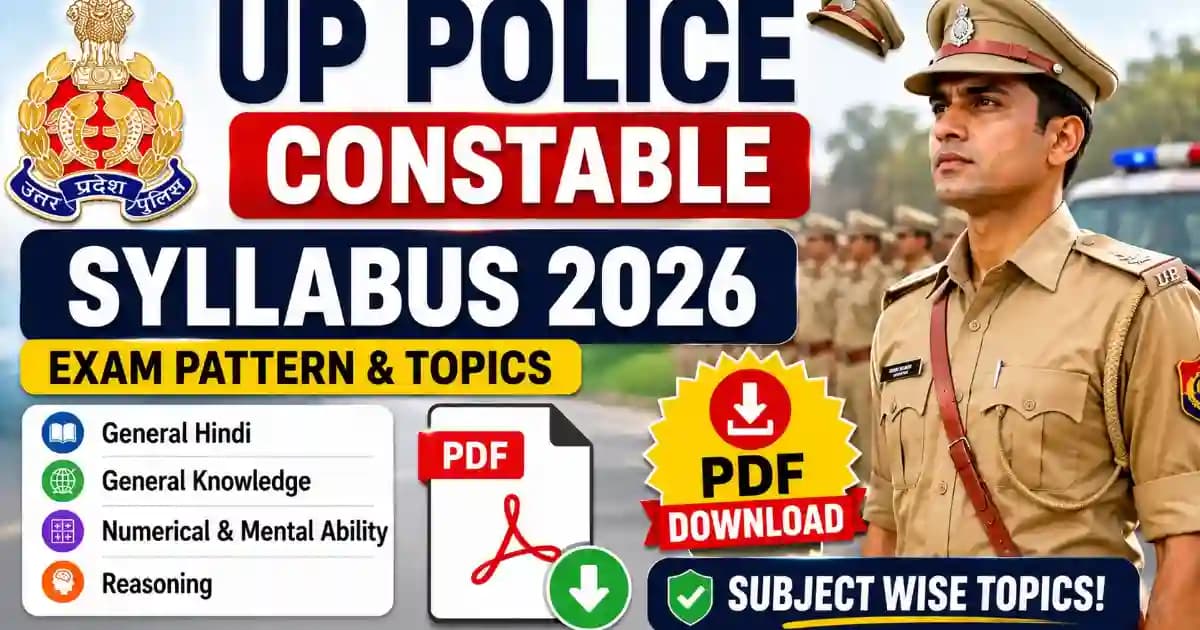
UP Police Constable Syllabus 2026 PDF released by UPPRPB for 32,679 posts. Exam on 8–10 June 2026. Complete subject-wise topics: GK, General Hindi, Numerical Ability, Mental Aptitude/IQ/Reasoning. No negative marking. Download at uppbpb.gov.in.
Uttar Pradesh Police Recruitment & Promotion Board (UPPRPB) is the state-level body under the Government of Uttar Pradesh responsible for conducting recruitment and promotion processes for all ranks in the Uttar Pradesh Police department. Its official recruitment portal is uppbpb.gov.in.
UP Police Constable Syllabus 2026 – Overview
UP Police Constable recruitment is one of Uttar Pradesh's largest and most competitive government recruitment drives, consistently attracting over 20 lakh applicants each cycle. The 2026 edition — released by Uttar Pradesh Police Recruitment & Promotion Board (UPPRPB) — opens 32,679 posts for Constable Civil Police, PAC (Provincial Armed Constabulary), and Jail Warder across UP. The written examination is confirmed for 8th, 9th, and 10th June 2026. In a significant change for 2026, negative marking has been completely removed — wrong answers now score 0 marks instead of the earlier –0.5 deduction, making it strategically optimal to attempt all 150 questions. The exam covers four subjects: General Knowledge & General Science, General Hindi, Numerical & Mental Ability, and Mental Aptitude / IQ / Logical Reasoning — 300 marks in 2 hours, offline OMR-based. Minimum qualification is Intermediate (10+2) pass from any recognised board. Candidates aged 18 to 22 years are eligible (with relaxation for reserved categories as per UP Govt. norms). Online applications were accepted at uppbpb.gov.in during January–February 2026.
In the previous UP Police Constable recruitment cycle (2023/2024), UPPRPB had announced 60,244 vacancies — the 2026 drive marks a 45.8% decrease in total posts compared to that cycle, reflecting revised cadre requirements for the state.
| Parameter | Details |
|---|---|
| Conducting Body | Uttar Pradesh Police Recruitment & Promotion Board (UPPRPB) |
| Post Name | Constable Civil Police, PAC (Provincial Armed Constabulary) & Jail Warder |
| Total Vacancies | 32,679 Posts |
| Eligibility | 10+2 / Intermediate from a recognised board |
| Age Limit | 18 – 22 years (relaxation for SC/ST/OBC/PwD/Ex-Servicemen as per UP Govt. rules) |
| Exam Date | 8th, 9th, and 10th June 2026 (3 days, multiple shifts) |
| Exam Mode | Offline – OMR Based (Pen & Paper) |
| Language | Bilingual – Hindi & English |
| Total Questions | 150 Objective MCQs |
| Total Marks | 300 Marks |
| Marks per Question | +2 Marks per correct answer |
| Negative Marking | NONE – Completely removed for 2026 (wrong answer = 0 marks) |
| Duration | 2 Hours (120 minutes) |
| Syllabus Level | Class 10 to Class 12 standard |
| No. of Sections | 4 Sections – GK, Hindi, Numerical Ability, Mental Aptitude |
| Pay Scale | ₹21,700 – ₹69,100 (Pay Level 3, 7th CPC) |
| Official Website | uppbpb.gov.in |
Source: UPPRPB Official Notification | uppbpb.gov.in
UP Police Constable 2026 – Important Dates & Full Schedule
All confirmed and expected dates for UP Police Constable Recruitment 2026 are listed below. The written exam is spread across three days (8–10 June 2026) in multiple shifts to accommodate the large candidate volume across Uttar Pradesh.
| Event | Date / Period | Status |
|---|---|---|
| Official Notification Released | 31 December 2025 | Confirmed |
| Application Start Date | January 2026 | Confirmed |
| Application Last Date | February 2026 | Confirmed |
| Admit Card Release | May / June 2026 (1–2 weeks before exam) | Expected |
| Written Examination (Shift 1, 2, 3) | 8th, 9th & 10th June 2026 | Confirmed |
| Answer Key Release | June 2026 (within ~1 week of exam) | Expected |
| Result Declaration | July – August 2026 | Expected |
| PST / Document Verification | August – September 2026 | Expected (after result) |
| PET (Running Test) | September – October 2026 | Expected (after PST) |
| Final Merit List | October – November 2026 | Expected |
Source: UPPRPB Official Notification | uppbpb.gov.in
UP Police Constable 2026 – Exam Pattern & Marks Distribution
UP Police Constable 2026 is a single-paper written exam with 150 MCQs carrying 2 marks each — total 300 marks, to be completed in 2 hours. The four subjects have near-equal weightage (within 2 marks of each other). A consistent 70% across all four subjects will outperform a candidate scoring 90% in two subjects but 50% in the other two — balanced preparation is the key to a high rank.
| Subject | Questions | Maximum Marks | Weightage | Approx. Time |
|---|---|---|---|---|
| General Knowledge & General Science | 38 | 76 | 25.3% | ~30 min |
| General Hindi | 37 | 74 | 24.7% | ~28 min |
| Numerical & Mental Ability | 38 | 76 | 25.3% | ~32 min |
| Mental Aptitude / IQ / Logical Reasoning | 37 | 74 | 24.7% | ~30 min |
| TOTAL | 150 | 300 | 100% | 2 Hours |
UP Police Constable 2026 – Marking Scheme
| Answer Type | Marks | Note |
|---|---|---|
| Correct Answer | +2 Marks | – |
| Wrong Answer | 0 Marks | No penalty – major 2026 change |
| Unattempted | 0 Marks | Attempt all 150 questions |
Source: UPPRPB Official Notification | uppbpb.gov.in
UP Police Constable 2026 – Selection Process (All 3 Stages)
UP Police Constable 2026 selection follows three stages. The final merit list is prepared entirely on written examination marks — PST and PET are qualifying gates only and add zero marks to the final score.
| Stage | Process | Details | Nature |
|---|---|---|---|
| Stage 1 | Written Examination | 150 objective MCQs | 300 Marks | 2 Hours | Offline OMR | Bilingual (Hindi & English) | No negative marking | Merit-based – Final rank determined here |
| Stage 2 | Document Verification & Physical Standard Test (PST) | Original document verification (10th/12th marksheets, caste certificate, domicile, etc.) followed by physical measurements (height, chest for males, weight) | Qualifying only – adds 0 marks |
| Stage 3 | Physical Efficiency Test (PET) | Running race under timed conditions with separate standards for male/female and category; candidates failing PET are disqualified despite good written exam marks | Qualifying only – adds 0 marks |
Source: UPPRPB Official Notification | uppbpb.gov.in
UP Police Constable 2026 – Physical Standard Test (PST): Height, Chest & Weight
The Physical Standard Test (PST) for UP Police Constable 2026 is conducted at Stage 2, after the written exam result. Candidates must meet the minimum physical measurements stipulated by UPPRPB — failure at this stage means elimination from the recruitment regardless of written exam score. Chest measurement standards apply only to male candidates; female candidates are measured for weight proportionate to height.
| Category | Male – Height | Male – Chest (Unexpanded / Expanded) | Female – Height | Female – Weight |
|---|---|---|---|---|
| General / OBC / SC | 168 cm | 79 cm / 84 cm (+5 cm expansion mandatory) | 152 cm | Proportionate to height |
| ST Category | 160 cm | 77 cm / 82 cm (+5 cm expansion mandatory) | 147 cm | Proportionate to height |
Source: UPPRPB Official Notification | uppbpb.gov.in
UP Police Constable 2026 – Physical Efficiency Test (PET): Running Standards
The PET for UP Police Constable 2026 is a running race conducted under timed conditions after the PST stage. Start running practice from Day 1 of preparation — do not wait until the written exam result is declared. Male candidates should target 4.8 km in under 22 minutes (3-minute safety margin against the 25-minute cut-off); female candidates should target 2.4 km in under 12 minutes (2-minute safety margin).
| Category | Gender | Distance | Time Limit | Pace Required |
|---|---|---|---|---|
| General / OBC / SC | Male | 4.8 km | 25 minutes | ~5 min 12 sec / km |
| ST Category | Male | 4.8 km | 27 minutes | ~5 min 37 sec / km |
| General / OBC / SC | Female | 2.4 km | 14 minutes | ~5 min 50 sec / km |
| ST Category | Female | 2.4 km | 16 minutes | ~6 min 40 sec / km |
Source: UPPRPB Official Notification | uppbpb.gov.in
UP Police Constable Syllabus 2026 – Subject 1: General Knowledge & General Science (38 Qs / 76 Marks)
General Knowledge & General Science is the highest-priority section carrying 38 questions for 76 marks. UP-specific GK and current affairs carry the highest weightage within this subject — candidates from Uttar Pradesh must treat UP History, UP Geography, UP Police Structure, and UP Government Schemes as top-priority topics.
Indian History & Freedom Movement
| Topic | Key Sub-topics |
|---|---|
| Ancient India | Indus Valley Civilisation, Vedic Period, Maurya Empire (Ashoka), Gupta Empire, Rise of Buddhism & Jainism, major dynasties |
| Medieval India | Delhi Sultanate (5 dynasties), Mughal Empire (Babur to Aurangzeb), Maratha Empire, Sikh Empire under Ranjit Singh |
| Modern India & Freedom Movement | 1857 Revolt (First War of Independence), Formation of INC (1885), Non-Cooperation Movement 1920, Civil Disobedience 1930, Quit India 1942, INA/Netaji |
| Important Years | 1857 revolt, 1885 INC, 1919 Rowlatt Act, 1947 Independence & Partition, 1950 Constitution adopted |
Indian Constitution & Polity
| Topic | Key Sub-topics |
|---|---|
| Preamble & Fundamental Rights | Preamble text & keywords; FR Articles 12–35 – right to equality, freedom, against exploitation, religion, culture, constitutional remedies |
| Directive Principles & Duties | DPSP (Part IV, Art 36–51) – non-justiciable but fundamental; Fundamental Duties (Art 51A) – 11 duties |
| Parliament | Lok Sabha (543 seats, 5-year term, Speaker), Rajya Sabha (250 max, VP as Chairman); legislative process; joint session |
| Executive | President (Art 52–62, powers), Vice-President, Prime Minister & Cabinet, Council of Ministers |
| Judiciary | Supreme Court (Art 124), High Courts, Subordinate courts; writ jurisdiction; PIL |
| Local Government | 73rd Amendment – Panchayati Raj (3-tier); 74th Amendment – Urban Local Bodies; 11th & 12th Schedules |
| Human Rights | NHRC, State HRCs; Child Rights (NCPCR, POCSO Act); Women's Commission; RTI Act 2005 |
| Emergency Provisions | Art 352 (National), Art 356 (President's Rule), Art 360 (Financial Emergency) |
Geography – India & World
| Topic | Key Sub-topics |
|---|---|
| Physical Geography of India | Himalayas (ranges, peaks), Indo-Gangetic Plain, Peninsular Plateau, Coastal Plains, Islands; soil types (alluvial, black, red, laterite) |
| Rivers of India | Himalayan rivers: Ganga, Yamuna, Brahmaputra, Ghaghra, Kosi. Peninsular: Godavari, Krishna, Kaveri, Narmada, Tapti. Tributaries & origin points |
| Climate | Monsoon mechanism (SW & NE monsoon), seasons, rainfall distribution, tropical/arid/temperate zones of India |
| Natural Resources | Coal (Jharkhand, WB), Iron ore (Odisha, Chhattisgarh), Petroleum (Assam, Gujarat), forests (types – tropical evergreen, deciduous, mangrove) |
| Agriculture | Kharif crops (Rice, Maize, Cotton – sown June-July), Rabi crops (Wheat, Barley, Mustard – sown Nov); Green Revolution, Blue Revolution |
| World Geography | Continents & oceans; important deserts (Sahara, Thar, Gobi); mountain ranges; international date line & time zones |
| Population | Census 2011 data – total population, density, sex ratio, literacy rate, most/least populated states |
Indian Economy
| Topic | Key Sub-topics |
|---|---|
| Economic Planning | NITI Aayog (replaced Planning Commission 2015); Five-Year Plans history; Sustainable Development Goals |
| Banking & Finance | RBI (functions, repo rate, reverse repo, CRR, SLR); commercial banks; NABARD; monetary policy; inflation control |
| GST | Goods & Services Tax (implemented July 2017); 4 slabs (0%, 5%, 12%, 18%, 28%); GSTIN; One Nation One Tax concept |
| Demonetisation | 8 November 2016 – ₹500 & ₹1000 notes withdrawn; objectives, impact on economy; digital payments boost |
| Commerce & Trade | Balance of trade vs balance of payments; India's major exports (IT, gems, pharma) & imports (crude oil, gold, electronics) |
| Government Schemes | PM Jan Dhan Yojana, MNREGA, PM Ujjwala Yojana, Atal Pension Yojana, Skill India, Make in India, Digital India |
General Science
| Topic | Key Sub-topics |
|---|---|
| Physics | Newton's Laws, Force & Motion, Work-Energy-Power; Electricity (Ohm's Law, circuits); Magnetism; Light (reflection, refraction, lenses); Sound (frequency, amplitude) |
| Chemistry | Elements & Periodic Table basics; Acids, Bases, Salts; common chemical reactions; Metals & Non-metals; Polymers; common chemicals in daily life |
| Biology | Cell structure (plant vs animal cell); Nutrition in plants & humans; Circulatory, respiratory, digestive systems; diseases (bacterial, viral, protozoan); vaccines |
| Space & Technology | ISRO missions (Chandrayaan, Gaganyaan, Mangalyaan); Satellites; key inventions & inventors; cybercrime types & IT Act 2000 |
| Environment & Ecology | Food chains & food webs; ecosystems; air/water/soil pollution; climate change & global warming; ozone layer; biodiversity hotspots |
| Health & Disease | Communicable diseases (TB, Malaria, Dengue, COVID); non-communicable diseases (diabetes, hypertension); nutrition deficiencies; immunisation |
Uttar Pradesh – Special Focus (High Priority)
| Topic | Key Sub-topics |
|---|---|
| UP History | Ancient Ayodhya, Mathura, Varanasi, Prayagraj; Awadh Nawabs; UP's role in 1857 revolt; prominent freedom fighters from UP |
| UP Geography | 75 Districts, 18 Divisional Headquarters; major rivers (Ganga, Yamuna, Ghaghra, Betwa, Chambal, Ken); UP borders 9 states + Nepal |
| UP Administration & Polity | Vidhan Sabha – 403 seats; Vidhan Parishad – 100 seats; Governor, CM; Revenue system – Tehsil, Block, Gram Panchayat |
| UP Police Structure | DGP → ADG → IG → DIG → SSP/SP → CO → SHO hierarchy; Zones, Ranges, Districts, Police Circles, Police Stations |
| UP Economy | GDP contribution; major industries (Agra leather, Firozabad glass, Varanasi silk, Moradabad brass, Mirzapur carpets); MSME sector; tourism revenue |
| UP Government Schemes | Mukhyamantri Kanya Sumangala Yojana; UP Scholarship; One District One Product (ODOP); UP Startup Policy; Free Tablet/Smartphone scheme |
| UP Culture & Heritage | UNESCO World Heritage Sites (Taj Mahal, Agra Fort, Fatehpur Sikri); Kumbh Mela (UNESCO intangible heritage); Classical dance (Kathak); Cuisine |
Current Affairs – National & International
| Topic | Key Sub-topics |
|---|---|
| Awards & Honours | Bharat Ratna, Padma Vibhushan/Bhushan/Shri; Nobel Prizes (recent years); Olympic/CWG medals; Filmfare, National Film Awards; Sahitya Akademi |
| Books & Authors | Recently published books by Indian authors; Booker Prize winners; notable international books; books by PM Modi & other leaders |
| Sports | India's performance in Olympics 2024 (Paris); Cricket ICC events; Hockey; Chess (FIDE World); Badminton; CWG; Asian Games |
| Important Days | National: Jan 26 (Republic Day), Aug 15 (Independence), Oct 2 (Gandhi Jayanti), Nov 14 (Children's Day). International: major UN days |
| Countries, Capitals, Currencies | New countries; currency changes; capital shifts; G20 members; BRICS members; SCO members; SAARC nations |
| International Organisations | UN (HQ NY), WHO (Geneva), IMF, World Bank (Washington DC), WTO (Geneva), SCO (Beijing), G20, ASEAN, NATO |
| Security & Defence | Internal security; terrorism & counter-terrorism; NIA; CRPF, BSF, CISF, ITBP roles; India's border disputes; cyber security |
| India & Neighbours | India-China relations (LAC, Arunachal Pradesh); India-Pakistan (LoC, J&K); India-Nepal; India-Bangladesh; India-Sri Lanka |
| Technology & Innovation | AI developments; India's space achievements; 5G rollout; cybercrime types; Digital India milestones; StartUp India ecosystem |
| Social Media & Cybercrime | Social media role in society; cyber bullying, phishing, ransomware; IT Act 2000 key sections; IT Amendment Act 2008; CERT-In |
Source: UPPRPB Official Notification | uppbpb.gov.in
UP Police Constable Syllabus 2026 – Subject 2: General Hindi (37 Qs / 74 Marks)
General Hindi carries 37 questions for 74 marks. Grammar rules (Sandhi, Samas, Karak, Ling, Vachan) and vocabulary (Synonyms, Antonyms, Idioms, Proverbs) are the highest-scoring areas. Master grammar rules first before moving to literature and comprehension.
Hindi Language – Introduction
| Topic | Key Sub-topics |
|---|---|
| Hindi & Indian Languages | Position of Hindi among 22 Scheduled languages; Hindi as official language of India (Art 343); classical languages of India |
| Dialects of Hindi | Khari Boli (standard Hindi base), Braj Bhasha, Awadhi, Bundeli, Bhojpuri, Maithili, Bagheli – features & regions |
| Devanagari Script | Structure of Devanagari; unique features vs other scripts; evolution from Brahmi; use across multiple Indian languages |
Varnamala – Hindi Alphabet
| Topic | Key Sub-topics |
|---|---|
| Swar (Vowels) | 11 vowels – short & long; Anuswar, Anunaasik, Visarga; Matras (vowel signs) |
| Vyanjan (Consonants) | 33 standard consonants in 5 Vargas (groups) by articulation point – Kanthya, Talavya, Murdhanya, Dantya, Aushthya |
| Tatsam Words | Sanskrit-origin words used unchanged in Hindi – e.g. Kaarya, Pustak, Nayak, Aadar. Very commonly tested |
| Tadbhav Words | Words modified from Sanskrit over time – e.g. Haath (from Hasta), Ghee (from Ghrita), Raat (from Ratri) |
| Deshaj & Foreign Words | Native origin (Deshaj) words; loanwords from Arabic (Kitab, Kaanoon), Persian (Baazar, Dil), English (Station, Doctor) |
Sandhi – Euphony (Sound Joining)
| Type | Key Sub-topics |
|---|---|
| Swar Sandhi (Vowel) | Dirgha Sandhi (aa+aa=aa), Guna Sandhi (a+i=e), Vriddhi Sandhi (a+e=ai), Yaan Sandhi, Ayadi Sandhi – rules & examples |
| Vyanjan Sandhi (Consonant) | Rules when consonants join – voiced/unvoiced changes; nasal transformations; Visarg changes to consonants |
| Visarg Sandhi | Visarga transformation rules – when it becomes "s", "r", "sh" or other sounds before different consonants |
Samas – Compound Words
| Type | Key Sub-topics |
|---|---|
| Avyavibhav Samas | Indeclinable compound – first word is dominant; mostly uses Avyay – e.g. Pratyeksha (before each) |
| Tatpurusha Samas | Second word dominant; classified by case suffix (Karmdharaya, Dviguu sub-types) – most common type in exams |
| Karmadharaya | Sub-type of Tatpurusha – adjective + noun or noun + noun with qualifier relation |
| Dvandva Samas | Both words equal – joined by "and" – e.g. Mata-Pita (mother-father), Daal-Bhat (lentils-rice) |
| Bahuvrihi Samas | Neither word is main – compound refers to something else – e.g. Dashanan (Ravana with 10 heads) |
| Dviguu Samas | First word is a numeral – e.g. Trimurti (three forms), Saptaah (7 days = 1 week) |
Vyakaran – Core Grammar
| Topic | Key Sub-topics |
|---|---|
| Ling (Gender) | Pulling (masculine) vs Stri-Ling (feminine); gender transformation rules; common exceptions frequently tested |
| Vachan (Number) | Ekvachan (singular) to Bahuvachan (plural) transformation – rules for different word endings |
| Karak (Case) | 8 cases: Karta (nominative), Karma (accusative), Karan (instrumental), Sampradan (dative), Apadaan (ablative), Sambandh (genitive), Adhikaran (locative), Sambodhan (vocative) |
| Sarvnaam (Pronoun) | 6 types: Purush-vachak, Nishchay-vachak, Anishchay-vachak, Sambandh-vachak, Prashn-vachak, Nij-vachak – forms & usage |
| Visheshan (Adjective) | Gun-vachak, Sankhya-vachak, Parimaan-vachak, Sarvnaamik; three degrees: Positive, Comparative, Superlative |
| Kriya & Kaal (Verb & Tense) | Sakarma (transitive) & Akarma (intransitive); Past – Samanye/Asanmanye/Purna; Present – 4 sub-types; Future – 3 sub-types |
| Vaachya (Voice) | Kartri-vaachya (active), Karma-vaachya (passive), Bhaav-vaachya – transformations between voices |
| Avyay & Upsarg/Pratyay | Indeclinables (Avyay); Prefixes (Upsarg) – Sanskrit, Hindi, Urdu origin; Suffixes (Pratyay) – Krit & Taddhit |
| Viraam-chinh (Punctuation) | Purn-Viraam (.), Ardh-Viraam (;), Prashna (?), Uddharan (" "), Yojak (-), Nirdesak (—), Koma (,) – correct usage |
Shabd Bhandar – Vocabulary
| Topic | Key Sub-topics |
|---|---|
| Paryayavachi (Synonyms) | 300+ synonym groups commonly tested: Agni=Paavak=Anala=Vahni; Jal=Neer=Vaariji=Udak; Soorya=Divakar=Ravi=Bhaanu |
| Vilom (Antonyms) | 200+ antonym pairs: Andhera-Ujala, Aadi-Ant, Videsh-Swadesh, Narak-Swarg, Saral-Kathin, Ujada-Abaad |
| Anekarthak (Polysemous) | Words with 2+ meanings: Karan (ear/reason/instrument), Arth (meaning/money), Kaal (time/death/tense) |
| Ek Shabd (One-word Substitution) | 100+ one-word substitutions: "Jo mara na ja sake" = Amar; "Jo bahut bolata ho" = Vaachaal; "Sapte mein padhna" = Adhyayan |
| Samroopi Bhinnarthak | Look-alike words with different meanings: Saar/Shaar, Din/Deen, Kul/Kool, Agya/Agyaa – distinguish by context |
| Muhavare (Idioms) | 150+ idioms: "Aankh ka taara" (very dear), "Haath dhona" (to lose), "Naak katna" (lose honour), "Taal thok ke" (confidently) |
| Lokoktiyan (Proverbs) | 100+ proverbs: "Jiski laathi uski bhains", "Ek aur ek gyarah hote hain", "Naach na jaane aangan tedha" |
Sahitya – Hindi Literature
| Topic | Key Sub-topics |
|---|---|
| Ras (Aesthetic Sentiment) | 9 Rasas: Shringar (beauty/love), Hasya (humour), Karuna (compassion), Raudra (fury), Veer (heroism), Bhayanaka (terror), Bibhatsa (disgust), Adbhut (wonder), Shaant (peace) |
| Chhand (Meter) | Doha (13+11 Matras), Chaupai (16+16), Savaiya (23 Matras), Kundaliya (Doha+Rolaa) – structure & identification |
| Alankar (Figures of Speech) | Anupras (alliteration), Yamak, Shlesha, Upma (simile), Rupak (metaphor), Utpreksha (fancy), Atishayokti (hyperbole), Manvikaran |
| Apathit Bodh (Comprehension) | Unseen passage – identify main idea, infer author's purpose, answer vocabulary & inference questions within the passage |
| Famous Poets | Medieval: Tulsidas (Ramcharitmanas), Kabir, Mirabai, Surdas. Modern: Mahadevi Verma, Nirala, Pant, Dinkar, Bacchan (Madhushala) |
| Famous Prose Writers | Premchand (Godan, Nirmala), Harivanshrai Bachchan, Jaishankar Prasad (Kamayani), Mahadevi Verma (Mera Parivar) |
| Literary Periods | Adikal (900–1350), Bhaktikal (1350–1650, golden age), Ritikal (1650–1850), Adhunik Kal (1850–present) |
| Hindi Awards | Sahitya Akademi Award, Vyas Samman, Jnanpith Award for Hindi, Bhartendu Harischandra Award, Moortidevi Award |
Source: UPPRPB Official Notification | uppbpb.gov.in
UP Police Constable Syllabus 2026 – Subject 3: Numerical & Mental Ability (38 Qs / 76 Marks)
Numerical & Mental Ability carries 38 questions for 76 marks at Class 10 level — speed and accuracy with shortcut techniques are critical. Mathematics accounts for roughly 70% of this section; Percentage, Ratio, SI/CI, Profit-Loss, Time-Work, and Mensuration together form the core of the arithmetic portion.
Part A – Numerical Ability (Arithmetic & Mathematics)
| Topic | Key Concepts & Formulae |
|---|---|
| Number System | Natural, whole, integer, rational & irrational, real numbers; divisibility rules (2, 3, 4, 5, 6, 8, 9, 11); prime & composite numbers; prime factorisation; HCF & LCM – prime factorisation method, division method |
| Simplification & BODMAS | BODMAS rule (Brackets → Orders → Division → Multiplication → Addition → Subtraction); fractions (proper, improper, mixed); decimal operations; surds and indices; laws of exponents; approximation questions |
| Percentage | % increase/decrease formula; successive % change; Expenditure = Population × Rate; Profit/Loss % = (P/L ÷ CP) × 100; population-based % problems; New Value = Original × (1 ± r/100) |
| Ratio & Proportion | Simple ratio (a:b); compound ratio; duplicate/triplicate ratio; direct proportion (x∝y) and inverse proportion (x∝1/y); mixture problems; alligation method; partnership – simple and weighted |
| Profit, Loss & Discount | CP, SP, MP definitions; Profit = SP – CP; Loss = CP – SP; Discount % = (Discount ÷ MP) × 100; SP = MP × (1 – D/100); successive discounts: (100–d1)(100–d2)/100; dishonest shopkeeper problems using false weights |
| Simple & Compound Interest | SI = P×R×T÷100; CI = P(1+R/100)^T – P; Half-yearly CI: R becomes R/2, T becomes 2T; Quarterly: R/4, T×4; Difference between CI and SI for 2 years = P(R/100)²; find rate/time/principal from given SI or CI |
| Average | Average = Sum ÷ Count; weighted average; average speed = 2xy/(x+y) for equal distances at different speeds; age problems; running average; missing term from average |
| Time & Work | If A does work in "a" days, efficiency = 1/a; LCM method for combined work; work and wages proportional to work done; Pipes & Cisterns: inlet pipe fills, outlet empties – net rate; MDH formula: M1D1H1 = M2D2H2 |
| Time, Speed & Distance | Distance = Speed × Time; unit conversions (km/h to m/s: ×5/18); relative speed: same direction = |S1–S2|, opposite = S1+S2; trains: length matters when crossing poles/platforms/other trains; Boats & Streams: Downstream = B+S, Upstream = B–S, B = (D+U)/2 |
| Mensuration (2D & 3D) | 2D – Square: area=a², perimeter=4a; Rectangle: l×b, 2(l+b); Triangle: ½bh, Heron's formula; Circle: πr², 2πr; Trapezium: ½(a+b)×h. 3D – Cube: V=a³, SA=6a²; Cuboid: lbh, 2(lb+bh+hl); Cylinder: πr²h, 2πr(r+h); Cone: ⅓πr²h, πrl+πr²; Sphere: 4/3πr³, 4πr² |
| Algebra | Linear equations in 1 & 2 variables; simultaneous equations (substitution, elimination); quadratic equations (factorisation, quadratic formula); key identities: (a+b)²=a²+2ab+b²; (a–b)²=a²–2ab+b²; a²–b²=(a+b)(a–b); (a+b)³; (a–b)³ |
| Data Interpretation | Bar graphs (vertical/horizontal), Pie charts (% to degrees: ×3.6), Line graphs, Tables; common question types: find total, find %, find ratio, find change over periods |
Part B – Mental Ability (Reasoning)
| Topic | Key Sub-topics |
|---|---|
| Logical Diagrams / Venn Diagrams | Circles representing sets; find number of members in intersection/union/exclusive zones; classify groups using diagrams. Very common in UP Police exams |
| Symbol-Relationship Questions | Standard mathematical symbols (=, ≠, >, <, +, –) replaced by custom symbols; decode the mapping and solve expressions |
| Analogy (Relationship Finding) | Word analogy: Car:Petrol :: Lamp:? | Number analogy: 3:9::5:? | Figure analogy. Identify the relationship and apply |
| Coding-Decoding | Letter coding (AD means shift by 3); number coding (words → numbers); mixed coding. Decode given words using discovered pattern |
| Series Completion | Number series (arithmetic, geometric, Fibonacci, mixed operations); alphabet series (position-based); alpha-numeric series – find the next term |
| Word Formation | Form a meaningful word from given letters; rank of a word in dictionary; number of words that can be formed |
| Direction & Distance | 8 compass directions (N, NE, E, SE, S, SW, W, NW); calculate net distance after multiple turns; shadow-based direction problems |
| Blood Relations | Family tree analysis; generation-based relations. "A is the son of B's father's brother" type multi-step problems |
| Classification (Odd One Out) | Find the item that doesn't belong – based on letters, numbers, shapes, or general knowledge categories |
| Ranking & Seating Arrangement | Position from top/bottom/left/right; linear and circular seating; find position of one person relative to another |
Source: UPPRPB Official Notification | uppbpb.gov.in
UP Police Constable Syllabus 2026 – Subject 4: Mental Aptitude / IQ / Logical Reasoning (37 Qs / 74 Marks)
Mental Aptitude / IQ / Logical Reasoning is unique to UP Police – this subject does NOT appear in SSC or Railway exams. It has three sub-sections. The critical strategy for Mental Aptitude (Part A) is that correct answers always prioritise: (1) Public Interest over personal interest, (2) Legal Procedure over shortcuts, (3) Non-discrimination over community bias, (4) Professional Ethics over personal loyalty. The answer principle is fixed and predictable across all police scenario questions.
Part A – Mental Aptitude (Police Values & Ethics – Scenario-based)
| Topic | Key Sub-topics |
|---|---|
| Public Interest & Service Mentality | Police must prioritise welfare of the public above personal convenience, community loyalty, or political pressure. Questions test this attitude through scenarios |
| Law & Order Maintenance | Handling riots, protests, communal tensions – correct procedure: inform seniors, follow SOP, avoid force escalation, protect life & property |
| Communal Harmony & Non-discrimination | Treating all communities, religions, castes, and genders equally. Secular approach. No differential treatment based on identity |
| Crime Control & Prevention | Preventive policing; community policing; awareness drives; proper FIR registration; zero tolerance for crime |
| Professional Knowledge of Police System | UP Police hierarchy; jurisdiction; powers of different ranks; roles of DGP, SSP, CO, SHO; police station functions |
| Key IPC Sections | Section 302 (Murder), 307 (Attempt to Murder), 376 (Rape), 420 (Cheating), 379 (Theft), 498A (Cruelty by husband), 304B (Dowry Death) |
| Key CrPC Provisions | Section 154 (FIR), 161 (Examination of witnesses), 41 (Arrest without warrant), 107–116 (Security proceedings), 482 (High Court powers) |
| Rule of Law | Constitutional supremacy; no arbitrary action; judicial review; every action must have legal backing |
| Accountability & Transparency | Reporting corruption upward; avoiding misuse of power; citizen grievance redressal; transparency in FIR registration |
| Gender Sensitivity & Child Rights | Respectful treatment of women at police stations; POCSO Act awareness; anti-trafficking measures; NHRC guidelines on women in custody |
| Adaptability & Professionalism | Handling stress; working in adverse conditions (floods, elections, VIP duty); rural vs urban policing challenges |
| Social Media & Cybercrime Awareness | Recognising cyber fraud, phishing, online harassment; IT Act 2000; Section 66 (computer crime); role of Cyber Cell |
Part B – Intelligence Quotient (IQ)
| Topic | Key Sub-topics |
|---|---|
| Relationship & Analogy | Word pair, number pair, and figure-based analogies. Find the rule connecting the first pair and apply to the second |
| Spotting Differences | Identify differences between two similar images or patterns; spot the odd one out from a set of figures |
| Problem Solving | Multi-step logical puzzles requiring step-by-step deduction; finding the solution through systematic elimination |
| Space Visualisation | Unfolded cube (dice problems – opposite faces); mirror images; water images; figure rotation in 90°/180° steps |
| Arithmetic Number Series | Complex series using arithmetic (+n), geometric (×n), prime numbers, squares, alternating operations – identify the pattern |
| Venn Diagram (IQ type) | Given three characteristics, use Venn circles to find: only A, only B, AB, ABC, at least two, etc. |
| Matrix & Sequence | Row/column pattern completion in figure matrices; number matrices with missing cells |
| Alphabet Position Tests | Position of letters from A=1 to Z=26; reverse alphabet Z=1; find letter at position X from left/right of word |
Part C – Logical Reasoning
| Topic | Key Sub-topics |
|---|---|
| Observation & Attention to Detail | Carefully identify minute differences in patterns, pictures, or sequences. Common in police recruitment to test observational skills |
| Discrimination | Accurately distinguish between look-alike items; classify items into correct categories based on subtle differences |
| Verbal Reasoning – Statements & Conclusions | Given statements, identify which conclusions logically follow (definitely true, possibly true, or false) |
| Verbal Reasoning – Arguments | "Should X be done?" Identify strong vs weak arguments based on logic, not emotion or popularity |
| Syllogisms | Two or more premises → conclusion. Use Venn diagrams to validate. "All A are B; All B are C → All A are C" |
| Cause & Effect | From a set of events, identify which is the cause and which is the effect; distinguish from independent events |
| Non-Verbal – Pattern Completion | Complete an incomplete figure pattern; find the next figure in a series of shapes/patterns |
| Non-Verbal – Paper Folding | Identify the pattern when a folded & punched paper is unfolded; recognise embedded figures |
| Decision Making | Given a scenario with multiple options, apply logical reasoning and given conditions to choose the best action |
| Visual Memory | Briefly shown a figure; later identify it from choices. Tests short-term visual recall – important for police work |
| Critical Thinking | Evaluate the validity of arguments; identify assumptions, identify which statement strengthens/weakens an argument |
Source: UPPRPB Official Notification | uppbpb.gov.in
UP Police Constable 2026 – Eligibility Criteria
Intermediate (10+2) from any recognised board is the minimum qualification for UP Police Constable 2026 — graduation is not required. Both male and female candidates from Uttar Pradesh domicile are eligible, subject to age and physical standards.
Age Limit for UP Police Constable 2026
Age is calculated as on the cut-off date specified in the official notification. Relaxation is provided to reserved category candidates as per UP Government norms.
| Category | Minimum Age | Maximum Age | Relaxation |
|---|---|---|---|
| General / EWS (Male) | 18 years | 22 years | – |
| OBC (UP Domicile) | 18 years | 25 years | +3 years |
| SC / ST (UP Domicile) | 18 years | 27 years | +5 years |
| Ex-Servicemen | 18 years | As per UP Govt. rules | +5 years |
| PwD (Persons with Disability) | 18 years | 37 years | +15 years |
Educational Qualification for UP Police Constable 2026
Candidates must have passed Intermediate (10+2) or equivalent examination from any recognised Board of Secondary Education. No higher qualification is required. Candidates with graduation or above are also eligible.
UP Police Constable 2026 – Pay Scale & Salary
UP Police Constable 2026 selected candidates are appointed at Pay Level 3 under the 7th Central Pay Commission pay matrix. In addition to basic pay, constables receive DA, HRA, TA, and other allowances as per UP Government rules, making the total monthly emoluments substantially higher than the basic pay figure.
UP Police Constable 2026 Admit Card – How to Download
The UP Police Constable 2026 Admit Card has not been released yet. It will be available for download at uppbpb.gov.in approximately 1–2 weeks before the written examination date (8 June 2026). Candidates should keep their registration number and date of birth ready to log in and download the hall ticket.
How to Download UP Police Constable Syllabus 2026 PDF – Step by Step
The official UP Police Constable Syllabus 2026 PDF is available on the UPPRPB official portal. Follow these steps to access and download it directly from the government website.
- Visit the official UPPRPB website at uppbpb.gov.in using any web browser on mobile or desktop.
- On the UPPRPB homepage, look for the "Recruitment / Bharti" section or the "Latest Notifications" area.
- Click on the notification link for UP Police Constable Bharti 2026 (32,679 posts) to open the official notification page.
- Inside the notification, navigate to the Syllabus & Exam Pattern section or download the complete notification PDF which includes the detailed syllabus for all four subjects.
- Save the official PDF to your device. Cross-check the subject-wise topics in the notification against the detailed breakdown on this page to ensure comprehensive coverage.
- For the UP Police Official website with additional circulars and orders, also check uppolice.gov.in.
UP Police Constable 2026 – Official Links & Resources
| Resource | Link |
|---|---|
| UPPRPB Official Recruitment Portal | uppbpb.gov.in |
| UP Police Official Website | uppolice.gov.in |
| Official Notification PDF (Constable 2026) | uppbpb.gov.in – Latest Notifications section |
| UP Police Constable Admit Card 2026 | To be released – uppbpb.gov.in |
| UP Police Constable Answer Key 2026 | To be released after exam – uppbpb.gov.in |
Source: UPPRPB Official Notification | uppbpb.gov.in – All links verified as of May 2026.
UP Police Constable Syllabus 2026 – Frequently Asked Questions
How many vacancies are there in UP Police Constable Recruitment 2026? +
UP Police Constable Recruitment 2026 has 32,679 total vacancies for the posts of Constable Civil Police, PAC (Provincial Armed Constabulary), and Jail Warder across Uttar Pradesh. These posts are spread across various districts and units of the UP Police department. This is a decrease from the 60,244 vacancies announced in the previous 2023 recruitment cycle, reflecting revised cadre requirements.
What is the exam date for UP Police Constable 2026? +
The UP Police Constable 2026 written examination is scheduled for 8th, 9th, and 10th June 2026 — spread across three days in multiple shifts to accommodate the large number of candidates across Uttar Pradesh. The exam is conducted in offline OMR-based mode (pen & paper) across exam centres statewide. Admit cards will be released approximately 1–2 weeks before the exam at uppbpb.gov.in.
Is there negative marking in UP Police Constable 2026? +
No — negative marking has been completely removed for UP Police Constable 2026. Wrong answers score 0 marks; previously, –0.5 marks were deducted per wrong answer. This is a major strategic change — candidates should attempt all 150 questions without fear of penalty. Each correct answer earns +2 marks, making the maximum score 300 marks from 150 questions.
What is the age limit for UP Police Constable 2026? +
The age limit for UP Police Constable 2026 is 18 to 22 years for General/EWS male candidates. OBC candidates (UP domicile) get 3 years relaxation (up to 25 years). SC/ST candidates (UP domicile) get 5 years relaxation (up to 27 years). Ex-servicemen get 5 years relaxation, and PwD candidates get 15 years relaxation (up to 37 years). Age is calculated as on the cut-off date specified in the official UPPRPB notification.
What is the salary for UP Police Constable 2026 selected candidates? +
UP Police Constable 2026 selected candidates receive a pay scale of ₹21,700 – ₹69,100 under Pay Level 3 of the 7th Central Pay Commission. In addition to basic pay, constables receive DA (Dearness Allowance), HRA (House Rent Allowance), TA (Travel Allowance), and other allowances as per UP Government rules. The expected in-hand monthly salary ranges from approximately ₹26,000 to ₹30,000 depending on posting location.
What are the height and chest requirements for UP Police Constable 2026? +
For General/OBC/SC male candidates, the minimum height is 168 cm with chest measurement of 79 cm (unexpanded) / 84 cm (expanded) — a minimum 5 cm expansion is mandatory. For ST male candidates, height is 160 cm with chest 77 cm/82 cm (+5 cm expansion). For General/OBC/SC female candidates, minimum height is 152 cm; for ST female candidates it is 147 cm. Female candidates are measured for weight proportionate to height instead of chest.
What is the PET running standard for UP Police Constable 2026? +
General/OBC/SC male candidates must complete 4.8 km in 25 minutes; ST male candidates must cover the same 4.8 km in 27 minutes. General/OBC/SC female candidates must complete 2.4 km in 14 minutes; ST female candidates must cover 2.4 km in 16 minutes. Start running practice from Day 1 of preparation — male candidates should target 4.8 km in under 22 minutes (3-minute safety margin) and female candidates should target 2.4 km in under 12 minutes (2-minute margin).
What is the Mental Aptitude section in UP Police Constable 2026 – is it the same as Reasoning? +
No — Mental Aptitude is distinctly different from Reasoning and is unique to UP Police. It does not appear in SSC or Railway exams. Subject 4 has three parts: Part A (Mental Aptitude) tests police values and ethics through real police scenarios — questions on law & order, FIR registration, communal harmony, and gender sensitivity. Part B (IQ) tests intelligence quotient through analogies, space visualisation, and number series. Part C (Logical Reasoning) tests verbal and non-verbal reasoning. Study 15–20 police scenario sample questions before the exam — the correct answer always prioritises public interest, legal procedure, and non-discrimination.
How is the final merit list prepared for UP Police Constable 2026? +
The final merit list for UP Police Constable 2026 is prepared entirely on written examination marks. PST (Physical Standard Test) and PET (Physical Efficiency Test) are qualifying stages only — they add zero marks to the final score. Candidates who pass PST and PET are ranked strictly on their written exam performance. A candidate with a higher written exam score will always rank above a candidate who performed better at PST/PET but scored lower in the written test.
UP Police Constable 2026 परीक्षा के लिए सिलेबस कहाँ से डाउनलोड करें? +
UP Police Constable 2026 का आधिकारिक सिलेबस PDF uppbpb.gov.in पर उपलब्ध है। वेबसाइट पर "भर्ती / Recruitment" सेक्शन में जाकर "कांस्टेबल भर्ती 2026 – 32,679 पद" के नोटिफिकेशन लिंक पर क्लिक करें और PDF डाउनलोड करें। परीक्षा 8, 9 और 10 जून 2026 को होगी। परीक्षा में 4 विषय हैं: सामान्य ज्ञान, सामान्य हिंदी, संख्यात्मक क्षमता, और मानसिक अभिरुचि / IQ / तर्कशक्ति — कुल 150 प्रश्न, 300 अंक, 2 घंटे। नकारात्मक अंकन 2026 में पूरी तरह हटा दिया गया है।
Can candidates from other states apply for UP Police Constable 2026? +
UP Police Constable 2026 is a state-specific recruitment and is primarily intended for candidates who are domicile of Uttar Pradesh. Domicile of UP is generally a mandatory requirement. However, candidates from other states may apply if they have a valid UP domicile certificate — verify the specific domicile conditions in the official UPPRPB notification at uppbpb.gov.in before applying, as requirements may vary by category.
Can I apply for both Civil Police and PAC with a single UP Police Constable 2026 application? +
Yes — a single application and the same written examination covers all three posts: Constable Civil Police, PAC (Provincial Armed Constabulary), and Jail Warder. There is no need to apply separately. Post allocation is based on merit in the written examination and the preference filled during the application process. Candidates who perform well and meet physical standards are allocated to their preferred post subject to availability.