
At a Glance
- Total Vacancies
- 1,829 posts across various UP Government departments
- Post Name
- Auditor — Lekha Pareekshak | Assistant Accountant — Sahayak Lekhakaar
- Eligibility
- B.Com OR Post-Graduate Diploma in Accountancy from a recognised university + O Level Computer Diploma (NIELIT) from a government-recognised institution + Valid PET-2025 Score Card
- Age Limit
- 21 to 40 years as on 01 July 2026 | OBC: +3 years | SC/ST: +5 years | PwBD & Ex-SM: as per UP Govt. rules
- Application Start Date
- 3 June 2026
- Salary
- Pay Matrix Level-5 (Uttar Pradesh Government Pay Matrix)
- Conducting Body
- Uttar Pradesh Subordinate Services Selection Commission (UPSSSC), Lucknow
Quick Summary
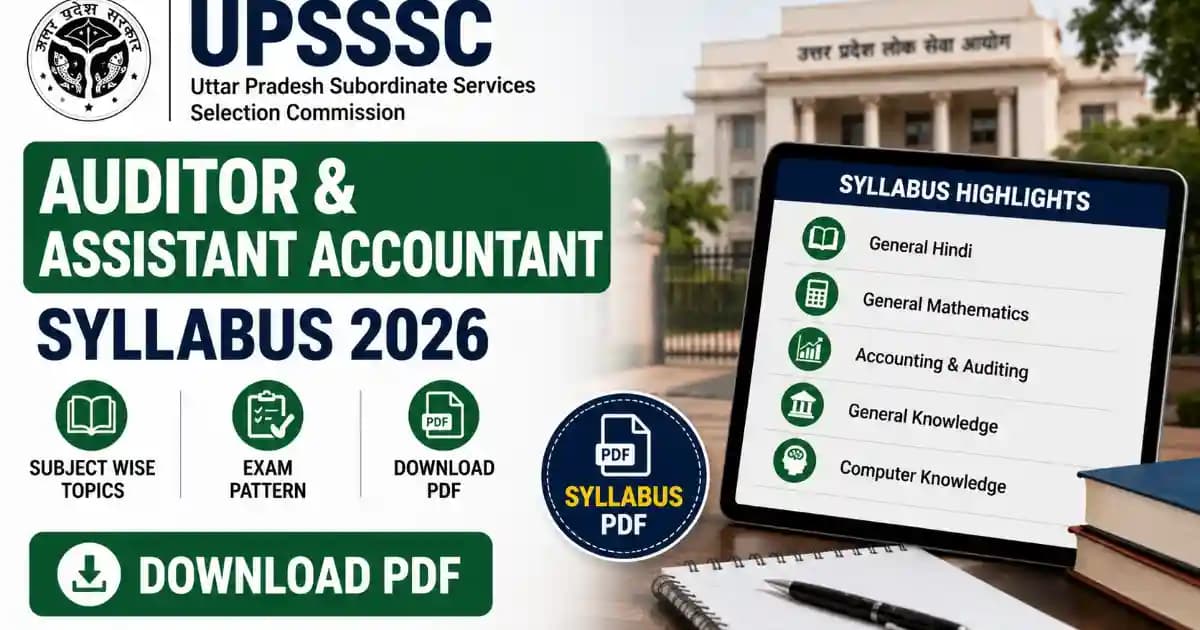
Download UPSSSC Auditor & Assistant Accountant Syllabus 2026 for Advt. 14-Exam/2026 — Part-wise topics for all 3 parts, exam pattern, marking scheme, preparation strategy and recommended books.
65 out of 100 marks in UPSSSC Auditor & Assistant Accountant 2026 come from just one section — Audit, Final Accounts & Fundamentals of Accounting — and every single topic in that section is drawn directly from a B.Com syllabus most candidates have already studied. UPSSSC released Advt. No. 14-Exam/2026 on 3 June 2026 for 1,829 posts; applications open 14 July 2026. This guide gives you the complete subject-wise syllabus for all three parts of the exam — every topic listed, explained, and ranked by exam weightage — along with the marking scheme, the 1/4 negative marking rule that most candidates ignore until it costs them the seat, a preparation strategy built around the actual part-wise weightage, and the recommended books for each section.
UPSSSC Auditor & Assistant Accountant 2026 – Exam Overview & Key Facts
This recruitment is for two post names that carry identical exam patterns and syllabus — Auditor (Lekha Pareekshak) and Assistant Accountant (Sahayak Lekhakaar). The selection process has no interview — your Main Written Exam score determines the final merit list. Document Verification is a qualifying step only. The merit list ranks candidates purely by marks obtained in the 100-mark written exam.
| Parameter | Details |
|---|---|
| Conducting Body | Uttar Pradesh Subordinate Services Selection Commission (UPSSSC), Lucknow |
| Advertisement Number | Advt. No. 14-Exam/2026 (Vigyan Sankhya-14-Pariksha/2026) |
| Post Names | Auditor — Lekha Pareekshak | Assistant Accountant — Sahayak Lekhakaar |
| Total Vacancies | 1,829 posts across various UP Government departments |
| Notification Date | 3 June 2026 |
| Application Window | 14 July 2026 to 3 August 2026 (online at upsssc.gov.in) |
| Fee Reconciliation / Amendment | Last date: 10 August 2026 |
| Application Fee | ₹25 (online processing charge — all categories: UR, OBC, SC, ST) |
| Age Limit | 21 to 40 years as on 01 July 2026 | OBC: +3 years | SC/ST: +5 years | PwBD & Ex-SM: as per UP Govt. rules |
| Educational Qualification | B.Com OR Post-Graduate Diploma in Accountancy from a recognised university + O Level Computer Diploma (NIELIT) from a government-recognised institution + Valid PET-2025 Score Card |
| PET Requirement | Must have appeared in UPSSSC PET-2025 and possess a valid PET-2025 Score Card — mandatory. PET-2025 score is used for shortlisting before Main Exam. |
| Pay Scale | Pay Matrix Level-5 (Uttar Pradesh Government Pay Matrix) |
| Selection Process | PET-2025 Shortlisting → Online Application → Main Written Exam → Document Verification → Final Merit List |
| Interview | No interview — merit determined entirely by Main Written Exam marks |
| Official Website | upsssc.gov.in |
Source: UPSSSC official notification Advt. No. 14-Exam/2026 — upsssc.gov.in (released 3 June 2026). Data verified as of 5 June 2026.
UPSSSC Auditor & Assistant Accountant Exam Pattern 2026 – Marking Scheme & Part-Wise Weightage
The Main Written Examination has 100 MCQ questions for 100 marks in 2 hours. It is divided into three parts. There is no sectional time limit — you manage all 3 parts within the same 120-minute window.
| Part | Subject | Questions | Marks | Weightage | Suggested Time |
|---|---|---|---|---|---|
| Part 1 | Audit, Final Accounts & Fundamentals of Accounting | 65 | 65 | 65% | ~80 minutes |
| Part 2 | Computer & Information Technology | 15 | 15 | 15% | ~20 minutes |
| Part 3 | General Knowledge of Uttar Pradesh | 20 | 20 | 20% | ~20 minutes |
| Total | All 3 Parts Combined | 100 | 100 | 100% | 2 Hours |
| Answer Type | Marks | Rule |
|---|---|---|
| Correct Answer | +1 mark | 1 mark per correct MCQ |
| Wrong Answer | −0.25 marks (1/4) | 1/4 mark deducted per wrong answer — applies to all 3 parts |
| Unattempted / Skipped | 0 marks | No penalty for leaving blank — skip when genuinely unsure |
Source: UPSSSC Auditor & Assistant Accountant official notification Advt. No. 14-Exam/2026 — upsssc.gov.in. Exam pattern verified as of 5 June 2026.
UPSSSC Auditor Syllabus 2026 – Part 1: Audit, Final Accounts & Accounting (65 Marks)
Part 1 carries 65% of the total marks and is the sole deciding factor in most candidates' scores. Every topic here is covered in B.Com — but government accounting, GFR, and audit-specific topics need separate preparation. The section covers five major areas: Book-Keeping, Audit, Final Accounts, Banking, and Taxation.
Section A: Book-Keeping & Fundamentals of Accounting
| Topic | Key Sub-Topics to Cover | Exam Importance |
|---|---|---|
| Double Entry System | Every transaction has two aspects — debit and credit. Rules for Personal accounts (Debit the receiver, Credit the giver), Real accounts (Debit what comes in, Credit what goes out), Nominal accounts (Debit all expenses and losses, Credit all incomes and gains). | High — foundation for journal, ledger, and all accounting topics |
| Journal | Book of prime/original entry. Format: Date | Particulars | L.F. | Dr. Amount | Cr. Amount. Narration below each entry. Compound journal entries. | High — tested directly and as foundation for other topics |
| Ledger | Secondary book of accounts. T-format accounts. Posting from journal. Balancing ledger accounts (Dr/Cr balance). Casting and carrying forward. | High |
| Trial Balance | List of ledger balances to check arithmetic accuracy. Methods: Total method, Balance method. Does not ensure accuracy of all errors — types of errors not revealed by Trial Balance. | High |
| Subsidiary Books | Cash Book (single/double/triple column), Petty Cash Book (analytical/imprest), Purchase Book, Sales Book, Purchase Returns Book, Sales Returns Book, Bills Receivable Book, Bills Payable Book. Uses and formats of each. | High — frequently tested in accounting exams |
| Bank Reconciliation Statement (BRS) | Reconciling balance as per Cash Book vs Passbook. Causes of difference: unpresented cheques, uncleared deposits, bank charges, interest credited/debited, errors. Format and preparation of BRS from both sides. | High — very common in government accounting exams |
| Rectification of Errors | Types: Errors of Omission, Errors of Commission, Errors of Principle, Compensating Errors. One-sided vs two-sided errors. Rectification before Trial Balance (direct journal). Rectification after Trial Balance (Suspense Account). Effect of errors on profit and capital — exam favourite. | Very High — 3–5 questions expected from this topic |
| Depreciation — Methods | Straight Line Method (SLM): Fixed amount = (Cost – Scrap) ÷ Life. Written Down Value (WDV): Fixed % on book value each year — used in IT Act. Sum of Years Digits (SYD): accelerated depreciation. Units of Production: based on actual output. Revaluation Method: for loose tools. Annuity and Sinking Fund methods. Journal entries for each method. | High — calculation questions common |
Section B: Audit & Government Financial Rules
| Topic | Key Sub-Topics to Cover | Exam Importance |
|---|---|---|
| Introduction to Audit | Definition, objectives, and importance of audit. Financial audit vs Management audit. Independent examination of financial statements. Difference between audit and investigation. | High |
| Types of Audit | Statutory Audit, Internal Audit, Government Audit, Tax Audit, Performance Audit, Concurrent Audit, Forensic Audit. Purpose and scope of each type. | High — types are directly tested |
| Internal Audit | Purpose: detect errors and fraud before external audit. Scope, independence, and relationship with management. Internal vs external audit comparison. | High — specifically relevant to Auditor post |
| Comptroller & Auditor General (CAG) | Constitutional authority under Articles 148–151 of the Constitution. Role as Supreme Audit Institution of India. Reports to Parliament. Audits Union, States, and government companies. Types of CAG audit reports. | Very High — direct relevance to Auditor post in UP Govt. |
| Audit Evidence | Types of evidence: inspection, observation, inquiry, confirmation, recalculation, analytical procedures. Sufficiency (quantity) and appropriateness (quality/relevance) of evidence. | Moderate |
| Audit Report | Types: Unqualified (clean opinion), Qualified, Adverse, Disclaimer of opinion. Components of audit report. Basis for each type. Management letter and communication. | High |
| Vouching | Examination of documentary evidence (vouchers) supporting transactions. Vouching of receipts, payments, sales, purchases. Documentary evidence types. | High — frequently tested in govt. audit exams |
| Verification of Assets | Physical verification of fixed assets, stocks, investments, debtors, cash. Test of existence, ownership, valuation. Cut-off procedures. | High |
| Provision for Bad Debts | Specific provision (identified doubtful debts) vs general provision (% on debtors). Accounting treatment in P&L Account and Balance Sheet. Double entry for creating and writing off bad debts. | Moderate |
| Government Financial Rules (GFR) | General Financial Rules (GFR) — applicability and scope. Responsibility of Drawing & Disbursing Officers (DDO). Principles of financial propriety and discipline. Sanctions: administrative, financial, technical. Budget structure: Consolidated Fund, Contingency Fund, Public Account. Annual Financial Statement (AFS). Appropriation Accounts — control of government expenditure. Treasury Rules — receipts and payments. Pay and Allowances — leave salary, TA/DA claims. Store Purchase Rules — procurement, inspection, custody. Government Accounting — Fund-based accounting. CAG Audit Reports on Government Accounts. | Very High — directly related to the Auditor role in UP Govt. 5–8 questions expected |
Section C: Final Accounts & Advanced Accounting
| Topic | Key Sub-Topics to Cover | Exam Importance |
|---|---|---|
| Trading Account | Gross Profit/Loss calculation. Opening stock + Purchases + Direct expenses − Closing stock. Carriage inward, Wages, Factory expenses. Adjustments for returns, customs. | High |
| Profit & Loss Account | Net Profit/Loss calculation. All indirect expenses (admin, selling, financial) and indirect incomes. Gross Profit transferred from Trading A/c. Distinction between capital and revenue items. | High |
| Balance Sheet | Financial position statement. Assets: Fixed, Current, Intangible. Liabilities: Capital, Long-term, Current. ASSETS = LIABILITIES + CAPITAL. Marshalling of assets and liabilities (liquidity order vs permanence order). | High |
| Adjustment Entries | Outstanding expenses (accrued but not paid), Prepaid expenses (paid in advance), Outstanding income (earned but not received), Prepaid income (received in advance), Depreciation adjustments, Bad debts, Reserve for bad debts. Journal entries and placement in Final Accounts. | Very High — 3–5 questions expected on adjustments |
| Valuation of Closing Stock | Lower of Cost or Net Realisable Value (NRV) — as per AS 2. Methods: FIFO (First In First Out), LIFO (Last In First Out), Weighted Average Method. Impact on Gross Profit and Net Profit. | High |
| Capital vs Revenue Expenditure | Capital expenditure: creates asset or reduces liability, benefits >1 year. Revenue expenditure: day-to-day expenses, benefits within year. Deferred revenue expenditure: treated as mixed. Examples: legal fees on property purchase (capital), repair of machine (revenue). | High — conceptual questions common |
| Partnership Accounts | Partnership deed — contents and importance. Capital accounts: Fixed vs Fluctuating capital method. Profit sharing ratio. Admission of new partner: goodwill treatment, revaluation of assets. Retirement of partner: settlement, goodwill. Death of partner: executor's account. Dissolution: realisation account, cash distribution. Goodwill valuation: Average Profit, Super Profit, Capitalisation methods. | High — 4–6 questions expected |
| Company Accounts | Types of shares: Equity and Preference shares. Issue at par, premium, discount. Calls in arrears and advance. Forfeiture and reissue of shares. Issue of debentures — types and redemption. Reserves & Surplus: Capital Reserve, Revenue Reserve, Secret Reserve. Final accounts of companies. Dividend — interim vs final. Buyback of shares. Liquidation: preferential payments order. | High — 5–8 questions expected |
| Bills of Exchange | Parties: drawer, drawee, payee, endorsee. Discounting with bank, endorsement, dishonour, noting and protesting. Accommodation bills. | Moderate |
| Consignment Accounts | Consignor vs consignee. Normal loss and abnormal loss. Valuation of unsold stock at cost. Del credere commission. Journal entries for both parties. | Moderate |
| Hire Purchase Accounts | HP price vs cash price vs interest. Instalments. Calculation of interest (Actuarial and Straight Line methods). Default and repossession entries. | Moderate |
| Non-Profit Organisations (NPO) | Receipts & Payments Account (cash-based), Income & Expenditure Account (accrual-based), Balance Sheet. Distinction from P&L. Treatment of subscriptions, donations, legacies, entrance fees. | High — relevant to government/charitable body accounting |
| Ratio Analysis | Liquidity: Current Ratio (Current Assets / Current Liabilities), Quick Ratio (Liquid Assets / Current Liabilities). Solvency: Debt/Equity, Interest Coverage. Profitability: Gross Profit Ratio (GPR), Net Profit Ratio (NPR), Return on Equity (ROE), Return on Assets (ROA). Formulae and interpretation. | High — formulae directly tested |
| Fund Flow Statement | Sources of funds (long-term): issues of shares, debentures, long-term loans, sale of fixed assets. Uses of funds: redemption, purchase of fixed assets, net loss. Funds from operations calculation. Changes in working capital. | Moderate |
| Cash Flow Statement | Three activities: Operating (day-to-day business cash flows), Investing (purchase/sale of long-term assets), Financing (borrowings, equity, dividends). Direct vs Indirect method for operating activities. AS 3 / Ind AS 7 compliance. | High |
| Single Entry System / Incomplete Records | Statement of Affairs method: Assets − Liabilities = Capital. Profit/Loss calculation from opening and closing capital. Preparation of complete accounts from incomplete records. | Moderate |
| Self-Balancing Ledgers | Debtors Control Account (Total Debtors Account in General Ledger), Creditors Control Account (Total Creditors Account). Adjustment accounts. Reconciliation of control accounts. | Moderate |
| Branch Accounts | Dependent branch: goods sent at cost or invoice price, loading adjustment. Independent branch: full set of books maintained separately. Foreign branch: translation of financial statements. Remittances and reconciliation. | Moderate |
Section D: Banking, RTGS, NEFT & e-Banking
| Topic | Key Points to Cover | Exam Importance |
|---|---|---|
| Types of Banks | Central Bank (RBI), Commercial Banks (SBI, PNB, etc.), Cooperative Banks, Regional Rural Banks (RRBs), Development Finance Institutions, Small Finance Banks, Payment Banks. Role and differences. | Moderate |
| RBI – Reserve Bank of India | Functions: currency issuance, banker to government, lender of last resort, credit control, foreign exchange management, banker's bank. Monetary policy tools: Repo Rate, Reverse Repo Rate, CRR, SLR, Bank Rate, Open Market Operations (OMO), MSF. | High |
| Types of Bank Accounts | Savings Account, Current Account (no interest, no limit on withdrawals), Recurring Deposit (RD), Fixed Deposit (FD), NRI Accounts (NRE — freely repatriable, NRO — not freely repatriable, FCNR). Features and differences. | Moderate |
| RTGS — Real Time Gross Settlement | Minimum ₹2 lakh. Real-time settlement of large-value transactions. No upper limit. Available 24×7 since December 2020. Funds credited same day, instantly. | High — frequently tested in banking/accounts exams |
| NEFT — National Electronic Funds Transfer | No minimum amount. Settled in batches (half-hourly). Available 24×7 since December 2019. Used for retail transactions. Charges applicable but regulated by RBI. | High |
| IMPS — Immediate Payment Service | Immediate interbank transfer. Available 24×7. Limit: up to ₹5 lakh per transaction (revised). Works via mobile/internet banking. Initiated by customer — push transaction. | Moderate |
| UPI — Unified Payments Interface | Mobile payment system by NPCI. Instant fund transfer using Virtual Payment Address (VPA). Works 24×7. Major apps: PhonePe, Google Pay, Paytm, BHIM. UPI 2.0 features: overdraft, invoice-based payments. | Moderate |
| e-Banking Security | SSL/TLS encryption, HTTPS. Two-factor authentication (2FA). OTP. CAPTCHA. Strong password policies. Phishing attacks and prevention. | Moderate |
| Cheque & Payment Instruments | Cheque Truncation System (CTS): electronic clearing — cheque image sent electronically. Demand Draft (DD): pre-paid, bank-guaranteed instrument, stop payment not possible. Banker's cheque. Letter of Credit (LC) for international trade. Bank Guarantee — types: performance, advance payment, bid bond. | Moderate |
Section E: Taxation — GST & Income Tax Basics
| Topic | Key Points to Cover | Exam Importance |
|---|---|---|
| GST Overview | Comprehensive indirect tax from 1 July 2017. "One Nation, One Tax." Dual structure: CGST (Centre) + SGST (State) for intra-state; IGST (Centre) for inter-state. Replaces VAT, Excise, Service Tax. | High |
| GST Slabs | 0% (essential items — unbranded food grains, fresh vegetables). 5% (basic necessities — packaged food, life-saving drugs). 12% (standard goods). 18% (most services and goods). 28% (luxury/sin goods — cars, tobacco). HSN codes classify goods. | High — slab questions are directly asked |
| Types of GST | CGST: Central GST collected by Centre on intra-state supply. SGST: State GST collected by State on intra-state supply. IGST: Integrated GST on inter-state supply — collected by Centre then distributed to State. UTGST: for Union Territories without legislature. | High |
| Input Tax Credit (ITC) | Credit of GST paid on purchases set off against GST payable on output. Conditions for claiming ITC. Blocked credits under Section 17(5) — personal use items, motor vehicles for personal use, etc. | High |
| GST Registration | Mandatory if turnover > ₹40 lakh (goods) / ₹20 lakh (services). GSTIN: 15-digit identifier. Composition scheme for small taxpayers (turnover < ₹1.5 crore): pay flat % instead of regular GST, cannot claim ITC. | Moderate |
| GST Returns | GSTR-1: outward supplies (monthly/quarterly). GSTR-3B: monthly summary return (must be filed first). GSTR-9: annual return. GSTR-2A/2B: auto-populated ITC statement. Filing deadlines and late fees. | Moderate |
| GST Council | Constitutional body under Article 279A. Chaired by Union Finance Minister. Includes State Finance Ministers. Recommends GST rates, exemptions, and policies. Decisions by three-fourths majority. | Moderate |
| E-Way Bill | Electronic document required for movement of goods worth > ₹50,000 (inter-state or intra-state). Generated on e-waybill portal. Validity depends on distance (1 day per 100 km). Checked at check posts. | Moderate |
| Income Tax — Five Heads of Income | Salaries (employer-employee relationship). House Property (rental income or deemed income). Profits and Gains of Business/Profession. Capital Gains (short-term: held <24 months for most assets; long-term: held >24 months). Income from Other Sources (interest, dividends, winnings). | High |
| TDS — Tax Deducted at Source | Section 192: TDS on salary. Section 194C: TDS on contractor payments (1% individual, 2% company). Section 194I: TDS on rent (10%). Section 194J: TDS on professional fees (10%). TDS rates and thresholds — commonly asked in accounting exams. | High — TDS sections directly tested |
| Key Income Tax Concepts | Assessment Year (AY) vs Previous Year (PY). Gross Total Income (GTI). Deductions under Section 80C (max ₹1.5 lakh — LIC, PPF, ELSS, NSC, Home Loan Principal). Section 80D: Health Insurance. PAN — mandatory for specified transactions. Form 16 (salary TDS certificate). Form 26AS (tax credit statement). Advance Tax due dates: 15 June (15%), 15 Sep (45%), 15 Dec (75%), 15 Mar (100%). | High |
| New vs Old Tax Regime | New regime: lower slab rates but no deductions (80C, 80D, HRA, etc. not available). Old regime: higher slab rates but all deductions available. Default from AY 2024–25 is New Regime unless opted out. Understanding the trade-off. | Moderate |
Source: UPSSSC Auditor & Assistant Accountant official notification Advt. No. 14-Exam/2026 — upsssc.gov.in. Part 1 syllabus (Sections A–E) derived from official notification subject areas. Data verified as of 5 June 2026.
UPSSSC Auditor Syllabus 2026 – Part 2: Computer & Information Technology (15 Marks)
Part 2 carries 15 marks and is the easiest scoring section for most candidates — particularly those with O Level Computer Diploma (mandatory for eligibility). Cover all topics at a conceptual level. 15 questions in ~20 minutes means you should not spend more than 80 seconds per question here.
Basic Computer Concepts & Hardware
| Topic | Key Points to Cover |
|---|---|
| Generations of Computers | 1st (Vacuum Tubes — ENIAC), 2nd (Transistors), 3rd (ICs), 4th (VLSI Microprocessors), 5th (AI-based, parallel processing). Features and examples of each generation. |
| Types of Computers | Supercomputer (weather forecasting, nuclear simulations), Mainframe (large database processing), Mini, Micro, Personal Computer. Tablet, Smartphone. Analog vs Digital vs Hybrid. |
| CPU & Memory | CPU components: ALU (Arithmetic Logic Unit), CU (Control Unit), Registers. Primary Memory: RAM (volatile — loses data on power off), ROM (non-volatile — BIOS, firmware), Cache memory (fastest — L1, L2, L3). Secondary Storage: HDD, SSD, USB Flash Drive, DVD, Cloud storage. |
| Input & Output Devices | Input: Keyboard, Mouse, Scanner, Touchscreen, Microphone, Webcam, Barcode Reader. Output: Monitor (CRT, LCD, LED, OLED), Printer (Laser — dry ink, Inkjet — liquid ink, Dot Matrix — impact printer for carbon copies). |
| Number Systems & Conversions | Binary (Base 2 — 0,1), Octal (Base 8), Decimal (Base 10), Hexadecimal (Base 16 — 0–9, A–F). Conversions: decimal to binary, binary to decimal, binary to hexadecimal. Units: Bit (0/1) → Byte (8 bits) → KB (1024B) → MB → GB → TB → PB. |
Operating System & Word Processing (MS Word)
| Topic | Key Points to Cover |
|---|---|
| Operating System (OS) | Functions: process management, memory management, file management, device management, security. Types: Windows (GUI), Linux (open-source), macOS, Android, iOS. Single-user vs multi-user. Time-sharing vs batch processing. |
| MS Word | Creating, editing, formatting documents. Font (type/size/colour), Bold/Italic/Underline, Paragraph spacing, Margins, Page orientation. Mail Merge (letters to multiple recipients from a data source). Track Changes. Headers/Footers. Table of Contents. Styles and Templates. Printing settings (A4, A3, print preview). PDF creation. Tables: insert, merge, split cells. |
| Windows Shortcuts (High Priority) | Ctrl+C (Copy), Ctrl+V (Paste), Ctrl+X (Cut), Ctrl+Z (Undo), Ctrl+Y (Redo), Ctrl+S (Save), Ctrl+P (Print), Alt+F4 (Close window), Win+D (Show Desktop), Ctrl+A (Select All), Ctrl+F (Find). |
MS Excel, Internet & e-Banking Security
| Topic | Key Points to Cover |
|---|---|
| MS Excel Basics | Cells, Rows, Columns, Worksheets, Workbooks. Cell referencing: Relative (A1), Absolute ($A$1), Mixed ($A1 or A$1). Fill Handle. Freeze Panes. Page setup for printing spreadsheets. |
| Excel Formulas (High Priority) | SUM, AVERAGE, COUNT, COUNTA, MAX, MIN, IF (logical), VLOOKUP (vertical lookup — column index number), HLOOKUP (horizontal), INDEX, MATCH, SUMIF, COUNTIF. Nested formulas. Error types: #N/A, #VALUE!, #REF!, #DIV/0!. |
| Excel Charts & Data | Bar chart, Pie chart, Line chart, Column chart — when to use each. Pivot Table (summarise large data). Data Validation (restrict input types). Conditional Formatting (highlight cells based on rules). Sort and Filter. |
| Internet & WWW | Protocols: HTTP (Hyper Text Transfer Protocol), HTTPS (secure), FTP (File Transfer), SMTP/POP3/IMAP (email). Domain names, IP address, DNS (Domain Name System). Web browsers: Chrome, Firefox, Edge. Search engines. |
| Cybersecurity & IT Act | IT Act 2000 & Amendment 2008: Section 66 (computer-related offences — hacking), Section 67 (obscene content online), Section 43 (unauthorised access/damage). CERT-In (national cybersecurity agency). Malware types: Virus, Worm, Ransomware, Spyware, Trojan, Adware. Firewall, Antivirus, Encryption, VPN, Digital Signature, PKI. Phishing, Pharming, Social Engineering. |
Emerging Technologies — AI, ML, IoT, Cloud, Big Data
| Topic | Key Points to Cover |
|---|---|
| Artificial Intelligence (AI) | Simulation of human intelligence. Types: Narrow AI (task-specific — Siri, ChatGPT), General AI (theoretical), Super AI (beyond human). Applications: chatbots, image recognition, fraud detection, medical diagnosis, recommendation systems. |
| Machine Learning (ML) & Deep Learning | ML: systems learn from data without explicit programming. Types: Supervised (labelled data — classification, regression), Unsupervised (unlabelled — clustering), Reinforcement (reward-based). Deep Learning: multi-layered neural networks (CNNs for images, Transformers for NLP). Requires large datasets and GPU processing. |
| Internet of Things (IoT) | Network of physical devices connected via internet. Smart homes, smart cities, industrial IoT (manufacturing), healthcare IoT, agriculture IoT. Sensors, actuators, connectivity protocols: MQTT, CoAP, Zigbee. |
| Big Data | 5 Vs: Volume (huge amount), Velocity (real-time generation), Variety (structured + unstructured), Veracity (accuracy), Value (insight generation). Tools: Hadoop (distributed storage/processing), Spark, MapReduce. Analytics: descriptive (what happened), predictive (what will happen), prescriptive (what should be done). |
| Cloud Computing | On-demand computing resources via internet. Service models: SaaS (Software — Gmail, Office 365), PaaS (Platform — Google App Engine), IaaS (Infrastructure — AWS EC2, Azure VMs). Deployment: Public (AWS, Google Cloud), Private (enterprise-owned), Hybrid (combination). India's government cloud: MeghRaj (NIC). Benefits: scalability, cost-saving, accessibility. |
| Blockchain | Decentralised, distributed ledger technology. Immutable (cannot be altered once recorded). Applications: cryptocurrency (Bitcoin, Ethereum), supply chain transparency, land records, voting systems, digital identity. Smart contracts: self-executing code on blockchain. |
Source: UPSSSC Advt. No. 14-Exam/2026 Part 2 Computer & IT syllabus — mapped to O Level NIELIT curriculum. Data verified as of 5 June 2026.
UPSSSC Auditor Syllabus 2026 – Part 3: General Knowledge of Uttar Pradesh (20 Marks)
Part 3 covers 20 marks and focuses on UP-specific knowledge — not general national GK. Questions come from UP History, UP Geography, UP Economy, UP Government Schemes, and UP Administration. Preparing UP-specific content from a dedicated UP GK book is more efficient than a general GK approach.
UP History
| Period | Key Topics |
|---|---|
| Ancient UP | Ayodhya (birthplace of Lord Ram — Ramayana), Mathura (Lord Krishna — Mahabharata), Varanasi/Kashi (oldest living city), Prayagraj (Triveni Sangam — Ganga, Yamuna, Saraswati). Mahajanapadas of UP: Kosala (Ayodhya), Vatsa (Kaushambi/Prayagraj), Kuru (Hastinapura/Meerut), Panchala. Maurya Empire — Emperor Ashoka. Gupta Empire — Prayagraj as capital under Samudragupta. |
| Medieval UP | Kannauj as cultural centre. Delhi Sultanate extended to UP. Mughal rule — Agra as capital under Akbar, Jahangir, Shah Jahan. Taj Mahal (built 1631–1648 by Shah Jahan for Mumtaz Mahal). Awadh Nawabs — Lucknow as cultural capital. Wajid Ali Shah — last Nawab of Awadh. |
| 1857 and Modern UP | Meerut — starting point of 1857 Revolt (10 May 1857). Key leaders: Mangal Pandey (Barrackpore), Begum Hazrat Mahal (Lucknow), Rani Laxmi Bai (Jhansi). Lucknow Pact (1916). Champaran and Khilafat movements. Freedom fighters from UP: Jawaharlal Nehru (Allahabad), Lal Bahadur Shastri (Varanasi), Madan Mohan Malaviya (Prayagraj — founded BHU). |
UP Geography & Administration
| Topic | Key Points |
|---|---|
| Physical Features | Part of Indo-Gangetic Plain — largest state by population. Himalayan foothills in north (Terai region — dense forests, Dudhwa National Park). Vindhya range in south (Mirzapur, Chandauli). Rocky terrain of Bundelkhand in south-west. |
| Major Rivers | Ganga (enters UP at Bijnor — major river), Yamuna (Agra, Mathura, Prayagraj — merges with Ganga), Ghaghra/Saryu (Faizabad/Ayodhya), Gomti (Lucknow — UP's capital river), Rapti (Gorakhpur), Betwa (Jhansi area — merges with Yamuna), Ken, Chambal, Son, Sharda. |
| Administrative Divisions | 75 Districts, 18 Divisions (Mandals), 826 Tehsils, 59,163 villages (approx). Largest district by area: Lakhimpur Kheri. Most populous district: Prayagraj (Allahabad). Capital: Lucknow. High Court: Allahabad (principal bench) + Lucknow bench. |
| Borders of UP | Uttarakhand (North), Nepal (North), Bihar (East), Jharkhand (South-East), Chhattisgarh (South), Madhya Pradesh (South-West), Rajasthan (West), Haryana (North-West), Delhi (North-West), Himachal Pradesh (North-West). 9 states + 1 UT border UP. |
UP Economy, Finance & Industrial Clusters
| Topic | Key Points |
|---|---|
| UP Economy | Second largest state economy in India (after Maharashtra). Agriculture: UP is India's largest producer of sugarcane and wheat. Also major producer of rice, potato, mango, and guava. Food processing, leather (Agra), handicrafts, tourism. |
| Industrial Clusters (ODOP) | Noida/Greater Noida: IT, electronics, multinational companies. Kanpur: leather industry (largest leather city in UP), textiles, plastics. Agra: footwear, marble, Taj Mahal tourism. Moradabad: brassware (export hub). Firozabad: glass and bangles. Varanasi: silk sarees, Banarasi brocade. Meerut: sports goods, musical instruments. Aligarh: locks. Mirzapur/Bhadohi: carpets (global export). Lucknow: Chikankari (embroidery). One District One Product (ODOP) scheme — know which product belongs to which district. |
| UP Budget & Finance | State budget structure. Fiscal deficit and FRBM Act. UP Finance Commission. Revenue receipts (tax + non-tax) vs Capital receipts (loans, disinvestment). Consolidated Fund of UP, Contingency Fund of UP, Public Account of UP. |
UP Government, Polity & Administration
| Topic | Key Points |
|---|---|
| UP Legislature | Vidhan Sabha: 403 seats (largest in India). Vidhan Parishad: 100 seats (upper house). Governor as constitutional head. Chief Minister as head of government. Speaker of Vidhan Sabha. |
| UP Revenue Administration | District → Tehsil → Block → Gram Panchayat. DM (District Magistrate) heads district. SDM (Sub-Divisional Magistrate) heads sub-division. Tehsildar heads tehsil. Lekhpal maintains land records at village level. Patwari (another name for Lekhpal in some areas). |
| Local Government | Urban (74th Amendment): Nagar Mahapalika/Municipal Corporation (large cities), Nagar Palika Parishad/Municipal Council (medium towns), Nagar Panchayat (small urban areas). Rural (73rd Amendment): Zila Panchayat (district level), Kshettra Panchayat/Block Panchayat (block level), Gram Panchayat (village level). |
| UP Finance & Accounts Department | Directorate of Internal Audit — primary department where Auditors work. Directorate of Accounts & Entitlement — where Assistant Accountants work. Finance Department of UP Government. Role of DDO (Drawing & Disbursing Officer). Treasury offices at district level. |
UP Government Schemes & Current Affairs 2025–26
| Category | Key Schemes & Events |
|---|---|
| Social Welfare Schemes | Mukhyamantri Kanya Sumangala Yojana (₹25,000 in 6 stages for girl child). UP Free Tablet/Smartphone Scheme (for students). UP Scholarship (pre-matric and post-matric). Mukhyamantri Abhyudaya Yojana (free coaching for competitive exams). Mission Shakti (women safety). Kanya Vidya Dhan Yojana. |
| Economic & Agricultural Schemes | ODOP (One District One Product) — flagship economic scheme. UP StartUp Policy. Invest UP (investment summit). PM Kisan Samman Nidhi in UP. Kisan Karj Maafi (debt waiver). PM Awas Yojana in UP — rural and urban housing. PM Gati Shakti (multimodal infrastructure). |
| Infrastructure & Transport | Purvanchal Expressway (341 km — Lucknow to Ghazipur). Bundelkhand Expressway (296 km). Ganga Expressway (594 km — Meerut to Prayagraj — longest expressway in India). Metro Rail: operational in Lucknow, Kanpur (under construction), Agra (under construction), Varanasi (planned). Jewar International Airport (Noida — under construction, will be Asia's largest airport). |
| Tourism & Heritage | UNESCO World Heritage Sites in UP: Taj Mahal (Agra), Agra Fort, Fatehpur Sikri. Kumbh Mela (Prayagraj — UNESCO Intangible Cultural Heritage of Humanity). Ram Mandir consecration (Ayodhya — 22 January 2024). Sarnath (Varanasi — where Buddha gave first sermon). Mathura-Vrindavan (Krishna circuit). |
| UP Current Affairs 2025–26 | Recent UP government budgets and flagship schemes. New industrial policies announced in 2025. Global Investors Summit (GIS) outcomes. UP's performance in Ease of Doing Business rankings. Appointments of UP Governor, Chief Minister, and key administrative officers. Recent infrastructure completions. Any UP-specific constitutional/legal amendments. |
Source: UPSSSC Advt. No. 14-Exam/2026 Part 3 UP GK syllabus — upsssc.gov.in. Data verified as of 5 June 2026.
UPSSSC Auditor & Assistant Accountant 2026 – Preparation Strategy
| Priority | Action | Why |
|---|---|---|
| Priority 1 — Master Part 1 (65 marks) | Cover all accounting topics systematically: Book-Keeping → Audit → Final Accounts → Banking → GST. Spend 60–70% of your daily study time on Part 1 subjects. Solve 50+ numerical questions daily for depreciation, BRS, rectification, partnership, and ratio analysis. | Part 1 alone determines whether you get the post. 65 marks out of 100 — you cannot afford to leave any topic untouched here. |
| Priority 2 — Negative Marking Strategy | Never guess if you cannot eliminate at least 2 options. Skip genuinely unknown questions. Attempt Part 2 (Computer) and Part 3 (UP GK) fully — these are higher-certainty sections. In Part 1, be selective when unsure of an accounting calculation. | 1/4 negative marking: 4 wrong answers = 5 marks lost (4 × 0.25 deducted + 4 correct marks not earned). Your score = (correct × 1) − (wrong × 0.25). Accuracy matters more than number of attempts. |
| Priority 3 — Secure Part 2 Easy Marks (15 marks) | Cover all Computer topics at O Level standard — you should already have this from the O Level certificate. Focus: MS Excel formulas (VLOOKUP, IF, SUMIF), IT Act sections (43, 66, 67), Cloud models (SaaS/PaaS/IaaS), Number system conversions (Binary/Decimal). | 15 marks are achievable in 20 minutes if prepared. Don't lose free marks in Computer — these are the easiest guaranteed points in the exam. |
| Priority 4 — Smart UP GK Preparation (20 marks) | Focus UP GK preparation selectively: UP Government Finance structure (DDO, Treasury, Audit Directorate), ODOP district-product mapping (memorise 10–15 key pairs), UP Legislature (403 Vidhan Sabha seats, 100 Parishad seats), UP Government flagship schemes (Kanya Sumangala, Abhyudaya), UP Expressways (Purvanchal, Ganga — lengths and routes), Current affairs of UP 2025–26. | 20 marks from UP GK — selective study yields 15–18 marks with 30–40 hours of focused preparation. General national GK not needed — only UP-specific knowledge. |
| Priority 5 — Government Audit & GFR Topics | Specifically study CAG (Articles 148–151), GFR 2017 (General Financial Rules), DDO responsibility, Treasury Rules, Vouching, Audit evidence types, and types of Audit Reports. These are specific to the Auditor role and are tested in both Part 1 and Part 3 (UP Audit administration). | These topics appear ONLY in government accounting exams — not in standard B.Com curriculum. 5–10 questions are likely from GFR and government audit topics specifically. |
| Priority 6 — Previous Year Papers & Mock Tests | Solve the 2023 UPSSSC Auditor exam paper completely. Attempt full-length mock tests under timed conditions (100 questions in 120 minutes). Analyse subject-wise performance after every mock test. Fix weak topics in Part 1 identified by mock test performance. | Time management is the second biggest challenge after negative marking. Without practice under exam conditions, 120 minutes for 100 questions will feel rushed — especially in Part 1 calculations. |
UPSSSC Auditor & Assistant Accountant 2026 – Recommended Books & Resources
| Subject | Book Title | Author / Publisher | Best For |
|---|---|---|---|
| Accounting (Part 1 — Primary) | Advanced Accountancy Vol. 1 & Vol. 2 | R.L. Gupta & M. Radhaswamy (Sultan Chand) | Best standard reference — covers all accounting topics comprehensively. Vol. 1: Book-Keeping, Vol. 2: Company Accounts & Advanced topics. |
| Accounting (Part 1 — Concepts) | Financial Accounting | T.S. Grewal or S.N. Maheshwari (Sultan Chand) | Clear concepts with good examples. Widely used at B.Com level. Good for building conceptual foundation before moving to advanced topics. |
| Accounting (Part 1 — Advanced) | Advanced Financial Accounting | S.N. Maheshwari | Company accounts, partnership, NPO, branch accounts, hire purchase — all advanced Part 1 topics covered comprehensively. |
| Audit (Part 1 — Audit Section) | Principles of Auditing | B.N. Tandon (Sultan Chand) | Standard auditing textbook. Covers CAG, internal audit, audit reports, vouching, verification — all directly relevant to Auditor post. |
| Government Financial Rules (Part 1) | Government Accounting & Auditing | As per GFR 2017 and CAG guidelines | Government financial rules, treasury rules, DDO responsibility — topics unique to government accounting not found in standard textbooks. |
| Taxation — GST (Part 1) | GST & Income Tax | V.K. Singhania / Vinod K. Singhania (Taxmann) | GST fundamentals, ITC, returns, GST Council + Income Tax heads, TDS sections, advance tax — all covered comprehensively. |
| Banking (Part 1) | Banking & Financial Services | As per JAIIB standard (Indian Institute of Banking & Finance) | RTGS, NEFT, IMPS, UPI, RBI functions, banking products — all covered at the level required for this exam. |
| Computer (Part 2 — Primary) | O Level Study Material — Modules A1, A2, A3, A4 | NIELIT Official O Level Curriculum | Official O Level curriculum — covers all Computer topics in the exam at the exact level required. Most direct match to the Part 2 syllabus. |
| Computer (Part 2 — Supplementary) | Computer Awareness for Competitive Exams | Arihant Publications or Kiran Prakashan | Covers all basics + MS Office + Internet + Emerging Technologies at quick-revision format. Good for last-month preparation. |
| UP GK (Part 3) | Uttar Pradesh Samanya Gyan (UP GK) | Arihant Prakashan or Youth Competition Times | UP History, Geography, Economy, Polity, Schemes — all covered in one book specifically for UP government exams. |
| Practice Papers | UPSSSC Auditor Previous Year Solved Papers | Kiran Publications or Arihant (2023 exam papers with solutions) | Actual 2023 UPSSSC Auditor exam questions with detailed solutions — the single most valuable practice resource for this exam. |
UPSSSC Auditor & Assistant Accountant 2026 – Official Links
| Resource | Official Link |
|---|---|
| UPSSSC Official Website — Notification & Apply Online | upsssc.gov.in |
| Official Notification PDF — Advt. No. 14-Exam/2026 | upsssc.gov.in → Notifications → Advt. 14-Exam/2026 |
| Apply Online (active from 14 July 2026) | upsssc.gov.in → Apply Online → Auditor & Assistant Accountant 2026 |
| NIELIT O Level Certificate Verification | nielit.gov.in |
Application: 14 July – 3 August 2026 | Fee: ₹25 only | Updated 5 June 2026
UPSSSC Auditor & Assistant Accountant Syllabus 2026 – Frequently Asked Questions
UPSSSC Auditor 2026 mein kaun se 3 parts hain aur unka weightage kya hai? +
UPSSSC Auditor & Assistant Accountant 2026 Main Exam mein teen parts hain: Part 1 — Audit, Final Accounts & Fundamentals of Accounting: 65 questions, 65 marks (65% weightage — sabse important). Part 2 — Computer & Information Technology: 15 questions, 15 marks (15% weightage). Part 3 — UP ka Samanya Gyan: 20 questions, 20 marks (20% weightage). Kul: 100 questions, 100 marks, 2 ghante. Exam offline OMR-based hai.
UPSSSC Auditor 2026 mein negative marking hai kya? Kitni? +
Haan — 1/4 mark (0.25 marks) ki negative marking hai har galat answer par. Yani har 4 galat jawab se 1 mark extra kat jaata hai upar se. Agar aap 60 sahi karte hain aur 20 galat, toh score hoga: (60 × 1) − (20 × 0.25) = 60 − 5 = 55 marks. Isliye sirf wahi question attempt karein jisme se aap 2 options confidently eliminate kar sakein. Genuinely unknown questions skip karein — skip karne par koi penalty nahi.
What is the complete eligibility for UPSSSC Auditor 2026 — education, PET, and age? +
Three conditions must all be met simultaneously: (1) Educational Qualification — B.Com or Post-Graduate Diploma in Accountancy from a recognised university + O Level Computer Diploma from NIELIT or a government-recognised institution. (2) PET Requirement — Valid UPSSSC PET-2025 Score Card is mandatory. Candidates who did not appear in PET-2025 cannot apply regardless of their educational qualification. (3) Age — 21 to 40 years as on 01 July 2026. OBC: +3 years relaxation (up to 43 years). SC/ST: +5 years relaxation (up to 45 years). Ex-Servicemen and PwBD: as per UP Government rules.
UPSSSC Auditor 2026 ke liye apply kaise karein — kab se shuru hoga? +
UPSSSC Auditor & Assistant Accountant 2026 ke liye online application 14 July 2026 se shuru hogi aur last date 3 August 2026 hai. Apply karne ke liye upsssc.gov.in par jaayein, OTR (One Time Registration) complete karein ya apne existing UPSSSC account se login karein, phir Auditor recruitment ke liye apply karein. Application fee sirf ₹25 hai (online processing charge — sabhi categories ke liye). Fee payment last date bhi 3 August 2026 hai. Fee reconciliation aur amendment ki last date 10 August 2026 hai.
Which topics from UPSSSC Auditor Part 1 syllabus have the highest number of questions? +
Based on the official syllabus and previous UPSSSC Auditor exam papers, the highest question-density topics in Part 1 are: Rectification of Errors (3–5 questions), Depreciation methods (3–4 questions), Final Accounts with adjustments (4–6 questions), Partnership Accounts (4–6 questions), Company Accounts (5–8 questions), Government Financial Rules (GFR) (5–8 questions), Audit types and CAG (3–5 questions), and GST & TDS (4–6 questions). These 8 topic areas together can account for 35–50 of the 65 questions in Part 1.
Is there an interview in UPSSSC Auditor & Assistant Accountant recruitment 2026? +
No — there is no interview in the UPSSSC Auditor & Assistant Accountant 2026 recruitment. The selection process has only three stages: PET-2025 based shortlisting (already done) → Main Written Examination (100 marks) → Document Verification (qualifying step only). The final merit list and selection are entirely based on marks obtained in the Main Written Exam. Document Verification confirms eligibility — it does not add or reduce marks.
UPSSSC Auditor ki salary 2026 mein kitni hogi — pay level kya hai? +
UPSSSC Auditor (Lekha Pareekshak) aur Assistant Accountant (Sahayak Lekhakaar) dono posts ke liye pay scale Pay Matrix Level-5 hai (Uttar Pradesh Government Pay Matrix, 7th Pay Commission ke according). Level-5 mein basic pay approximately ₹29,200 se shuru hoti hai. Iske saath DA (currently ~50–60% of basic), HRA (city ke hisaab se), TA, medical benefits aur NPS (pension) milti hai. Actual in-hand salary posting city aur DA revision par depend karti hai — estimated ₹45,000 to ₹55,000 per month UP mein (metro aur non-metro ke hisaab se).
What books should I study for GFR and Government Audit topics in UPSSSC Auditor 2026? +
Government Financial Rules and audit topics are specific to government accounting and are not found in standard B.Com textbooks. Study these from: (1) GFR 2017 (General Financial Rules 2017) — the official document available at the Ministry of Finance website (finmin.nic.in). (2) "Principles of Auditing" by B.N. Tandon (Sultan Chand) — covers CAG, audit types, audit evidence, audit reports. (3) Any UP-specific government accounts manual or treasury rules compiled for state government employees — check UPSSSC previous year papers for GFR question patterns. For CAG specifically, Articles 148–151 of the Indian Constitution are a must-read.
UPSSSC PET 2025 score card nahi hai toh kya apply kar sakte hain? +
Nahi. UPSSSC Auditor & Assistant Accountant 2026 ke liye UPSSSC PET-2025 Score Card mandatory hai. Jo candidates PET-2025 mein nahi baithe, ya PET-2025 mein qualify nahi kiya (Score Card issue nahi hua), wo is recruitment ke liye eligible nahi hain — chahe unki educational qualification kitni bhi strong ho. Aisa candidates agla PET appear karke next UPSSSC Auditor cycle ka wait karein.
How many total vacancies are there in UPSSSC Auditor 2026 and which departments are included? +
A total of 1,829 vacancies have been announced under UPSSSC Advt. No. 14-Exam/2026. These are distributed across multiple departments of the Uttar Pradesh Government. Key departments include: Directorate of Internal Audit UP (major share of Auditor posts), UP State Legal Services Authority (Assistant Accountant posts), Finance & Accounts Departments of UP, and various other UP Government Ministries and Directorates. For the complete department-wise and category-wise (UR/OBC/SC/ST/EWS) vacancy breakdown, download the official notification PDF from upsssc.gov.in.