
At a Glance
- Eligibility
- UPSSSC PET 2025 Qualified
- Salary
- As per UP Government Rules
- Location
- Uttar Pradesh
Quick Summary
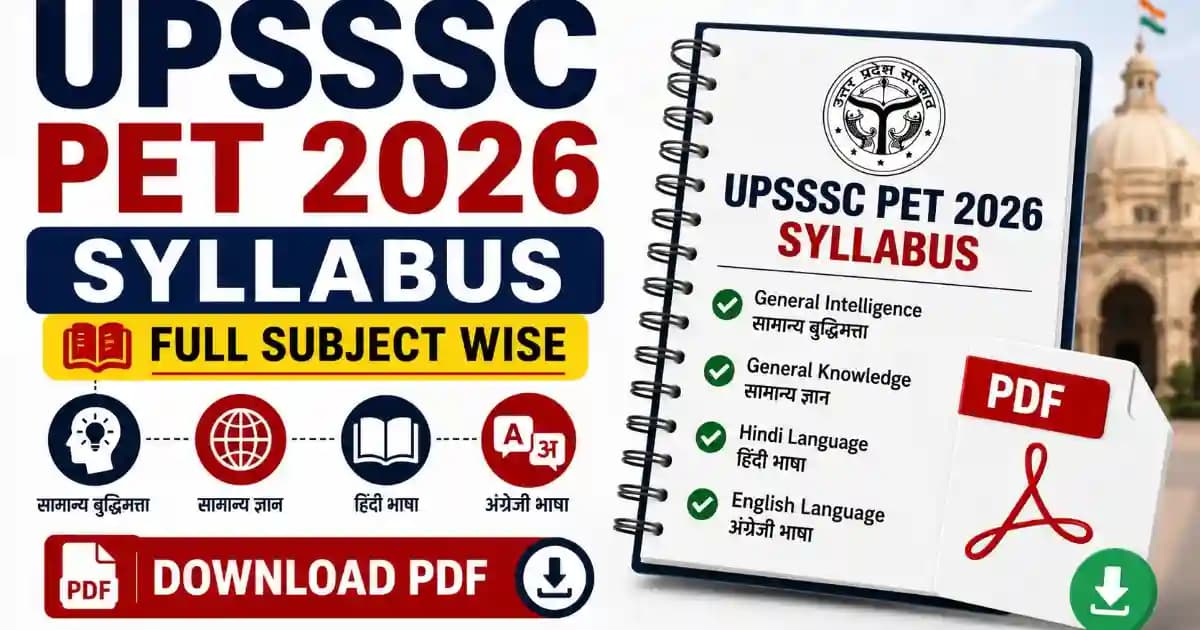
UPSSSC has released the official Examination Scheme and Syllabus for the Scientific Assistant and Laboratory Assistant Main Examination 2026. Check the complete exam pattern and download the PDF.
The Uttar Pradesh Subordinate Services Selection Commission (UPSSSC) has published the official Examination Plan and Syllabus for the Scientific Assistant & Laboratory Assistant Competitive Main Examination 2026 under the Office of Forensic Science Laboratory, Lucknow, Uttar Pradesh. Candidates shortlisted via PET-2025 can now check the detailed subject-wise syllabus and exam pattern to prepare for the main exam.
UPSSSC Scientific & Laboratory Assistant Exam Pattern 2026
The Main Examination will consist of a single objective-type (multiple-choice) question paper. It is divided into three parts: Subject Knowledge (Part-1), Computer & IT (Part-2), and UP General Knowledge (Part-3). The total duration of the exam will be 120 minutes (2 Hours).
| Part | Subject Name | No. of Questions | Total Marks | Time Duration |
|---|---|---|---|---|
| Part-1 | 1) Physics | 10 | 10 | Two Hours (120 Minutes) |
| 2) Chemistry | 10 | 10 | ||
| 3) Biology | 10 | 10 | ||
| 4) Mathematics | 10 | 10 | ||
| 5) Forensic Science | 25 | 25 | ||
| Part-2 | Knowledge of Computer, Information Technology, and Contemporary Technological Development | 15 | 15 | |
| Part-3 | General Information related to the State of Uttar Pradesh | 20 | 20 | |
| Total | 100 | 100 | ||
Detailed Syllabus: UPSSSC FSL Main Exam 2026
Part-1: Subject Knowledge
1. Physics (10 Marks)
- Mechanics: Units and dimensions, scalars and vectors, motion in one and two dimensions, Newton's laws of motion, work, energy and power, circular motion, gravitation, momentum and collisions, rotational motion, simple harmonic motion, elasticity, and viscosity.
- Heat and Thermodynamics: Temperature and heat, thermal expansion, laws of thermodynamics, heat transfer, kinetic theory of gases, specific heat, and latent heat.
- Waves and Sound: Wave motion, properties of waves, sound waves, Doppler effect, resonance, ultrasonics, and applications.
- Optics: Reflection and refraction, mirrors and lenses, lens maker formula, optical instruments (microscope, telescope), interference, diffraction, polarization, LASER basics, fiber optics.
- Electricity and Magnetism: Coulomb's law, electric field and potential, capacitance, current electricity, Ohm's law, Kirchhoff's laws, magnetic field, electromagnetic induction, AC, transformers.
- Electronics & Modern Physics: Semiconductors, diodes, transistors, digital electronics, logic gates, Bohr's model, photoelectric effect, X-rays, radioactivity, nuclear reactions.
- Radiation & Applied Physics in Forensics: Radioactive decay, radiation detectors, Microscopy, spectroscopy, principles of chromatography, imaging techniques, ballistics physics, trajectory analysis, fingerprint imaging systems.
- Experimental Physics: Vernier calipers, screw gauge, error analysis, measuring devices.
2. Chemistry (10 Marks)
- Physical Chemistry: Atomic structure, chemical bonding, states of matter, thermodynamics, chemical and ionic equilibrium, electrochemistry, redox reactions, chemical kinetics, surface chemistry, solutions.
- Organic Chemistry: General organic chemistry, hybridization, isomerism, hydrocarbons, alcohols, phenols, ethers, aldehydes, ketones, carboxylic acids, amines, polymers, biomolecules, named reactions.
- Inorganic Chemistry: Periodic table, coordination compounds, p-block, d-block, and f-block elements, transition elements, metallurgy, acids, bases, and salts.
- Analytical & Forensic Chemistry: Volumetric and gravimetric analysis, pH measurement, separation techniques (TLC, GC, HPLC), Spectroscopy (UV, IR, Mass, Atomic absorption). Basics of toxicology, narcotic drugs, explosives, petroleum products, paints, dyes, arson investigation.
- Biochemistry & Environmental Chemistry: Proteins, enzymes, carbohydrates, lipids, nucleic acids, water/air pollution, heavy metals, waste management.
3. Biology (10 Marks)
- Cell Biology & Genetics: Cell structure, mitosis/meiosis, Mendel's laws, chromosomes, DNA structure/replication, RNA, mutations, genetic disorders.
- Molecular Biology & Biotechnology: DNA fingerprinting, PCR, gel electrophoresis, recombinant DNA technology, cloning basics, Human Genome Project.
- Human Anatomy & Physiology: Digestive, respiratory, circulatory, nervous, excretory, endocrine, reproductive, skeletal, and muscular systems.
- Blood, Serology & Microbiology: Blood composition, ABO system, Rh factor, antigen-antibody reaction, blood stain examination. Bacteria, viruses, fungi, sterilization.
- Forensic Biology & Ecology: Biological evidence collection, hair/semen/saliva analysis, DNA profiling, human identification, wildlife forensics, basics of entomology. Ecosystem, biodiversity, environmental pollution.
4. Mathematics (10 Marks)
- Arithmetic & Algebra: Number system, LCM/HCF, ratio, percentage, profit/loss, simple/compound interest, time & work, speed & distance. Linear and quadratic equations, polynomials, logarithms, AP, GP.
- Geometry, Mensuration & Trigonometry: Lines, angles, triangles, circles, coordinate geometry, surface area and volume. Trigonometric ratios, heights, and distances.
- Statistics & Advanced Topics: Mean, median, mode, standard deviation, variance, data interpretation (graphs, charts). Permutation and combination, probability, matrices, determinants, basics of calculus (differentiation & integration).
- Logical Reasoning: Series, coding-decoding, blood relations, direction sense, syllogism, puzzles, Venn diagrams.
5. Forensic Science (25 Marks)
- General Forensic Science: History, development, scope, branches, role of FSL, ethics, quality assurance, Frye and Daubert standards.
- Crime Scene Investigation: Crime scene management, securing scenes, search methods (spiral, grid, zone), documentation (photography, sketching), collection and packaging of evidence, chain of custody.
- Physical and Biological Evidence: Hair, fibers, glass, paint, soil analysis. Fingerprint types and development methods, blood and body fluids.
- Forensic Biology, Toxicology & Chemistry: DNA extraction, PCR, poison classification, drug abuse analysis, explosives, arson investigation, chromatography, spectroscopy.
- Questioned Documents & Ballistics: Handwriting examination, forgery detection, counterfeit currency. Firearms, ammunition, internal/external/terminal ballistics, gunshot residue, tool marks.
- Cyber and Digital Forensics: Basics of computers/networks, cyber crimes, digital evidence, data recovery, mobile and internet forensics, IT Act basics.
Part-2: Computer & Information Technology (15 Marks)
- History, Introduction, and Application of Computer, IT, Internet, and WWW.
- Hardware and Software, Input and Output devices.
- Internet Protocol / IP Address, IT gadgets and their applications.
- Creation of e-mail ID and email operations.
- Operation of printers, tablets, and mobile devices.
- Important elements of Word Processing (MS-Word) and Excel Processing (MS-Excel).
- Operating System, Social Networking, e-Governance, Digital financial tools.
- Future skills, cyber security, AI, Big Data, Deep Learning, Machine Learning, IoT, and India's achievements in IT.
Part-3: UP General Knowledge (20 Marks)
- History, culture, art, architecture, festivals, folk dances, literature, and regional languages of Uttar Pradesh.
- Heritage, social customs, tourism, geographical landscape, and environment.
- Natural resources, climate, soil, forests, wildlife, mines, and minerals.
- Economy, agriculture, industry, business, and employment.
- Polity and administration, current events, and achievements of UP State in various fields.
Important Instructions & Shortlisting Criteria
- Shortlisting based on PET-2025: Candidates will be shortlisted for the Main Examination based on their normalized score in the Preliminary Eligibility Test (PET) 2025. Approximately 15 times the number of vacancies (category-wise) will be called for the main exam.
- Normalization: If the written examination is conducted in more than one shift/day, the normalization of scores will be applied as per the commission's guidelines dated 22 May 2019.
- Reservation Rules: Candidates claiming reservation must clearly indicate their category in the application. Out-of-state candidates will be treated as Unreserved (General). Ex-Servicemen reservation rules apply as per the latest UP Govt guidelines.
Bilingual (Hindi & English) Detailed Exam Pattern.
Official Links
| Download Syllabus PDF | Click Here |
| Official UPSSSC Website | upsssc.gov.in |